
(Nota bene: Yesterday was a holiday AND an encyclical came out. I did not get started on my newsletter, so you’re getting it today when you get it.)
Paid Pillar subscribers can listen to JD read this Pillar Post here: The Pillar TL;DR
Hey everybody,
Today’s the feast of St. Philip Neri, and you’re reading The Tuesday Pillar Post.
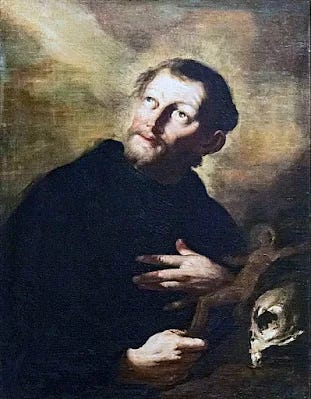
A brief sketch: He was born in 1515 to a noble family. After his mother died, Philip was raised by his grandmother in Florence, as a basically pious boy under the tutelage of local Dominicans. At 18, he moved in with an uncle, and around that time, he had a deep spiritual conversion.
Plans for a merchant’s career were put aside, as Philip felt a call to Rome, for reasons he couldn’t describe. Without his family’s money to back the play, he lived in a small attic room, ate cheap bread, tutored kids to pay the bills, and visited the tombs of the apostles and Roman martyrs, counting on the Lord to make clear why he was there.
Rome itself was in bad shape. The city had been sacked in 1527 by the Holy Roman Emperor — with the pope himself barely escaping capture. More than 1,000 people were executed. Homes and shops were all burned. Churches were desecrated by Lutheran soldiers. Women were raped by marauding soldiers and criminal bands.
The political effects across Europe were monumental. But in Rome, the effects were acute, and devastating. The city’s population dropped to just 10,000 people, from more than 50,000 prior. The remaining Romans were despondent and depressed. And for many, faith was lost entirely.
That was the Rome to which the Lord called Philip. It wasn’t a glorious place, it was a bombed out filthy city barely beginning to rebuild.
Philip, being a young and educated man, figured at first he was there for an education.
At the Augustinianum, he studied theology and philosophy. And then — praying before a large crucifix — he had a deeper conversion still.
He quit school, and became a kind of apostolic hermit. He started visiting hospitals, poor neighborhoods, and prostitutes — sitting down to talk with people, and inviting them to Christ. All of that was backed by prayer — he started praying in the catacombs, often spending the entire night there.
To a lot of people, Philip was weird. He didn’t belong to an order or a pious association. He wasn’t a cleric. He was just a guy, living in Rome, spending time on the fringes of society, and turning up everywhere to pray. That was an unusual way to live in 16th century Rome, and no one was quite sure what to make of him.
But he wasn’t personally weird. In fact, he was winsome. People liked him. And part of it was that he was hilarious. Philip was confident and funny — sharp as a tack, witty, and frequently self-deprecating.
So he went on like that for a while, and then when he was almost 30, Philip had a mystical experience. It was close to Pentecost. As he knelt in a catacomb, Philip experienced a ring of fire descend, and then enter his mouth, and then settle around his heart. He recalled that he was filled then with an extraordinary and intense love for God, which eventually was so intense he fell to the ground.
He rose after a few minutes of catching his breath, just absolutely full of joy. And the accounts say that his heart was literally swollen — that he had then an observable swelling in his chest, and that an autopsy later confirmed such an enlarged heart that two ribs were broken and reformed in a kind of arch to accommodate it.
Anyway, Philip’s life changed. He began forming young men as companions — inviting them to serve the sick with him, while teaching them to pray. Eventually they formed a little association.
Six years later, Philip was ordained a priest, and became a very busy confessor. He continued forming young men, and soon after founded the Congregation of the Oratory — the movement of clerical common life which eventually included St. John Henry Newman.
For all of that, he is remembered as the “third Apostle of Rome.”
He’s also remembered for being hilarious. And that’s why I like St. Philip Neri — I can think of almost nothing I’d like more for my life than to be remembered five centuries on for being funny. I mean, what’s better?
But Neri’s brand of funny is instructive. I read recently that Neri’s humor was focused on growth in humility, and patience — in himself and others.
When Neri showed up to a meeting with half his beard shaved off, it was to lighten some tension, and to remind himself — and others — that he wasn’t as great or important or oracular as people might say.
(This beard thing strikes me as more weird than funny, but maybe you had to be there.)
When he gave his brothers bad directions for wherever they were going, it was funny, but it was also an exercise in patience.
When he preached a sermon full of brazen mispronunciations, in front of a scholarly Latinist bishop, Neri was playing a game — arguably, he was trolling the guy — but it was also a bite at humility, a chance not to show off his own eloquence to a person of some stature.
Most of his humor came in less public moments. Most of the time, he was funny in small groups or cor ad cor conversations, in which he used his wit to make people feel comfortable. That’s the reason a nobleman’s son could sit and talk easily with prostitutes and dying invalids.
He wasn’t funny to own the libs. He wasn’t funny to vent his spleen. He was funny because God made him funny — and he used that for the glory of God.
The news
Pope Leo yesterday promulgated his first encyclical letter, Magnifica humanitas.
I’ve read most of it, but I haven’t read it twice or three times.
Yesterday was Memorial Day. And sure, I did my reporting diligence and got a text a few days early, but I don’t see much point in speedrunning the thing multiple times just to be another person with a hot take.
I have been reading both the laudatory and critical coverage of the encyclical, and I agree both that it sets a good foundation for an ethical conversation, and that its accommodating approach did not address several critical topics, including intellectual property, the difference between human genius and mechanistic process, and the staggering impact on the human intellect of outsourcing frequent thinking.
In short, it is both stronger in some sections than I expected, and surprisingly silent on topics I thought important to take up. We’ll be discussing that in depth on The Pillar Podcast this week, so tune in.
For now, here are some people with decidedly more wisdom.
First, Luke Coppen brings you an excellent reader’s guide, which unpacks the entire encyclical chapter by chapter. If you’re not going to read the whole thing, but you want to know what it drives at, Luke’s reader’s guide is exactly what you’re looking for.
Next, Edgar Beltran talked in Rome yesterday with (Pillar reader) Cardinal Michael Czerny and (possible?) Pillar reader Fr. Brendan McGuire — two clerics involved in the drafting and development of the text.
AI companies “are asking us ‘can you help us?’... So I think we have to meet them where they’re at,” McGuire told reporters.
He also emphasized that the encyclical is aimed as much toward Silicon Valley — and to continue a conversation — as to those who habitually read encyclicals.
“We’ve been in dialogue for years, but this isn’t the end,” the priest said.
Maybe that explains why I found certain things lacking in the text, because the encyclical is not meant to be comprehensive, but introductory — not the last word, but an introduction.
More on that in time to come, I’m sure.
But here’s some coverage that’s absolutely worth your time. Yesterday — with the help of our friend Charlie Camosy — we asked a panel of AI experts and theologians to read the text, and to engage in a liveblogging conversation with each other.
They delivered, and then some. This is a substantive and engaged conversation, between experts and with the text itself. If you’re looking for expert assessment, reading through this will give you ideas to chew on for quite a while.

You are called to grow in your Faith and to evangelize. Deepen your understanding of the biblical roots of Catholicism and confidently share your Faith with others by becoming a St. Paul Center Member. Encounter Christ. Share Christ. Visit https://stpaulcenter.com/memberships to get started for free.
The encyclical was not the only thing to happen in the Church this week.
Sunday was Pentecost, and here’s a look at the robust way the feast is celebrated in Brazil.
—
French Catholic leaders are prepared for such a discussion because they’ve already done a lot of research into why and how people convert — the U.S. bishops are well behind the frogs on this — giving them the opportunity to discuss how parishes can better train, incorporate, and support catechumens and neophytes discovering the Christian life.
—
Finally, it is worth noting that the leadership of the Society of St. Pius X has announced this week the names of four priests it intends to consecrate to the episcopacy, and by that, incur the penalty of schism.
We have spent a lot of ink at The Pillar on the SSPX, and we’ll doubtless spill more — in part because we’re watching in real time a new ecclesial rupture unfold, or at least be cemented, and one that comes with maddening insistence that disobedience is really the highest form of obedience.
There is some sense in which the consecration of the new bishops provides a sort of finality to the saga of the SSPX, who have occupied a gray area in ecclesiastical life for several decades. Priests will be consecrated bishops, they will be excommunicated, and the status of the society will more clearly reflect the break of ecclesial communion that goes unspecified in terms like “imperfect communion,” which have been favored by the Vatican in recent years.
The positive effect is that the break will offer Catholics — including the SSPX’s priests — a choice: You’re either obedient to the pope in a moment of black-and-white instruction, or you’ve thrown yourself in with disobedience, because of how you justify it.
That choice may see some SSPX Catholics choose to return to a more normalized sacramental life — especially if the pope seems more open to the liturgical preferences which often lead people to the SSPX in the first place.
But at the same time, the consecrations will have made four bishops who feel no compunction to obey the Supreme Pontiff when he gives them direct orders, and the Church’s ecclesiology is clear that whenever that happens, it’s a crisis.
Which is why I’m a bit surprised the pope hasn’t exercised an additional canonical option. Thus far, the Apostolic See has done all the penal law things that might be expected — issuing warnings with clear consequences, for those involved in the consecrations. I expect that the four announced priests will soon get personal warnings from the pope, outlining the imminent prospect of their declared excommunication, and the consequences thereof.
But if they disobey, they’ll still be bishops, consecrated with the episcopal character of the apostles’ successors, and with all the power that bishops have to ordain.
Except it doesn’t have to be this way.
Canon 841 establishes that “since the sacraments are the same for the whole Church and belong to the divine deposit, it is only for the supreme authority of the Church to approve or define the requirements for their validity.”
This is the canon which confirms that the Church can decree that Catholics can marry validly only according to canonical form, and before a delegated ecclesiastical witness, while other baptized Christians can contract the sacrament of marriage on horseback on the beach, or rappelling off the Sphere in Las Vegas, so long as they observe the civil law on marriage, making a true and recognizable consent to marriage’s essential goods and properties.
The Church sets strict requirements for Catholics who aim to validly contract marriage, because she believes those help to form Catholics to appreciate the sacred character of their marriages. And the Church has the power to do just that.
Which means, insofar as I can tell, that the pope can also decree that Catholic bishops can’t validly consecrate other bishops without a papal mandate. He would likely not want to take that so far as to say that no bishop can consecrate validly without a papal mandate — papal efforts to legislate over the Orthodox would set ecumenism back by about 500 years — but it’s not hard to imagine Catholic episcopal consecrations facing at least the same level of merely ecclesiastical regulation as Catholic marriages.
Now, I can’t be the first person to have conceived of this plan. But the pope hasn’t done it. And there may be good reason. But in case he’s reading it for the first time, I offer only that it’s within his power to do so, and that the canonists at The Pillar would be glad to suggest some colleagues who could draft the decree.
Technology and my moral agency
The promulgation of Magnifica humanitas has raised for me some relatively personal questions about technology and our magnificent humanity, questions that I’ve been reflecting on over the past few months.
The whole thing is rather personal, but in the manner of The Pillar, I don’t mind sharing with the few hundred thousand of you I’ve come to think of as close and personal friends.
See, since January 8th, I’ve lost about 65 pounds — which is, for me, just a start.
And I’ve done it with hard work, and exercise — and with the help of emerging medical technology.
It has been a transformative experience, but also a confounding one, which has challenged my perception of human will and human agency altogether.