
Hey everybody,
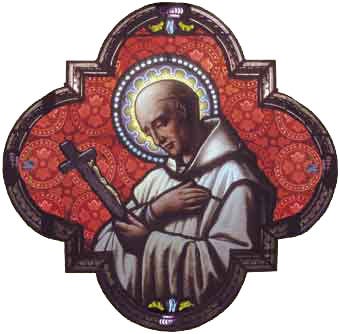
Today’s the feast of St. Bruno, and you’re reading The Tuesday Pillar Post.
I haven’t always known that October 6 was the feast of St. Bruno, but once I learned, I never forgot.
See, a kid named Bruno was the biggest bully in my little grade school class, and a socially awkward and bookish kid like me was the obvious focus of his attention.
When I eventually started paying attention to feast days, I felt convicted to pray for the guy on the feast of his namesake.
But October 6 is also my birthday. So every year on my birthday, I make it a point to pray for this guy — that he’s not a jerk anymore, and that the Lord has touched his life, called him to holiness, and given him every happiness.
It’s actually the greatest birthday custom I could have, for a very simple reason: It’s a reminder that my life is not about me. Neither is yours, for that matter.
And if there’s one person who understood that, it’s St. Bruno.
Bruno was born into a noble European family, he had important positions as a priest and head of schools, he became chancellor of the archdiocese of Reims, (as a former archdiocesan chancellor myself, I suppose I feel a certain kinship with him), and he became influential as a theologian across Europe — especially as his former pupils became themselves important Churchmen.
But Bruno was called to discomfort. When he became archdiocesan chancellor, the archbishop of Reims was a good man, and Bruno’s friend. His successor was not. The next archbishop was corrupt, he was morally bankrupt, and he had a penchant for violence. He rarely offered Mass. He was petty to his priests. He was a scandal.
And, Bruno, for his part, might have lain low, ridden things out, found himself some other appointment outside the diocese. He had his own reputation, and his own patrons, and his own friends. He would have been fine ignoring the scandal in the Archdiocese of Reims.
But he got involved anyway. He saw to it that his bishop was suspended from office, and then removed from office. And it was a battle at every level.
For his trouble, Bruno’s house was pulled down by the archbishop’s supporters. He seems to have lost his savings. He paid a price.
All of that seems to have brought him closer to the cross. Still, when the dust settled, he was done with ecclesiastical politics, or least he wanted to be. Bruno resigned his offices, and with some companions, began a new order of monastic life, of eremitical contemplation, study, and manual labor. They copied books, they chopped wood, they prayed the office. Much of their life was in solitude.
Bruno was content in the holy silence of his newly founded Carthusians.
But six years into it, the pope called. Urban II was Bruno’s former student. He was dealing with an antipope and a hostile emperor. And however content Bruno was in monastic contemplation, the pope needed him in the cesspool of Rome.
So Bruno went. Not for long, actually, because soon enough he and the pope had to flee Rome when the Holy Roman Emperor took over the city.
But Bruno helped calm things down. He helped stabilize the pope, and thus the entire Church. And only then did he get to go home, to a hermitage — not the one where he wanted to live, in Chartreuse, but one close enough to Rome that the pope could reach him at a moment’s notice. Lucky Bruno.
Anyway, he lived out his years there with a few brothers, “keeping an assiduous watch for the Lord, so as to open to him at once when he knocks.”
May we keep watch with him for the knocking of the Lord. May we have the magnanimity to say yes. May we be willing to go where Christ and his Church call us. And may St. Bruno intercede for us.
—
By the way, if, by chance,you did want to do something for my birthday, in addition to praying for ole’ Bruno, I’d be much obliged if you’d become a paying subscriber to The Pillar, or otherwise support its work.
This is how I serve the Church, and I’m grateful for everyone who’s joined the team:
The news
Cardinal Gambetti’s term at St. Peter’s was marked by a lot of controversy, especially over the decision to end the long-standing customary privilege of priests offering private Masses at the altars of St. Peter’s.
But it seems to say a lot, Ed Condon points out, that Pope Leo removed Gambetti without a replacement lined up. What it says, of course, remains to be seen.
—
Controversy continues over a legal challenge to baptismal records in Europe, with the EU bishops’ commission saying Monday that Church authorities across Europe would face “significant legal uncertainty” if baptismal registers could be subject to European data privacy laws.
This is a fascinating and complex case about how immemorial customs work amid laws designed to address modern digital privacy concerns.

The St. Paul Center App | Bible Study On-The-Go
Read and understand the Bible with St. Paul Center’s new app! With today’s leading Catholic Scripture scholars as your guides, the St. Paul Center app empowers you to read the Bible from the heart of the Church. Download the app for free at either the Apple or the Google app stores. https://stpaulcenter.com/app
Brazil’s presidential election campaign took a surprisingly Catholic-coded turn last week, with controversy over the official status of the country’s patron saint – Our Lady Aparecida – winding up in court.
As the country’s two leading presidential candidates head to a runoff, Incumbent president Lula da Silva’s supporters have accused challenger Flávio Bolsonaro of plotting to demote Our Lady of Aparecida from her legal status as Brazil’s patron saint.
The accusations made their way to court, and eventually saw dueling statue-based campaign rallies.
This is the kind of bizarre story you should read. Only at The Pillar.
—
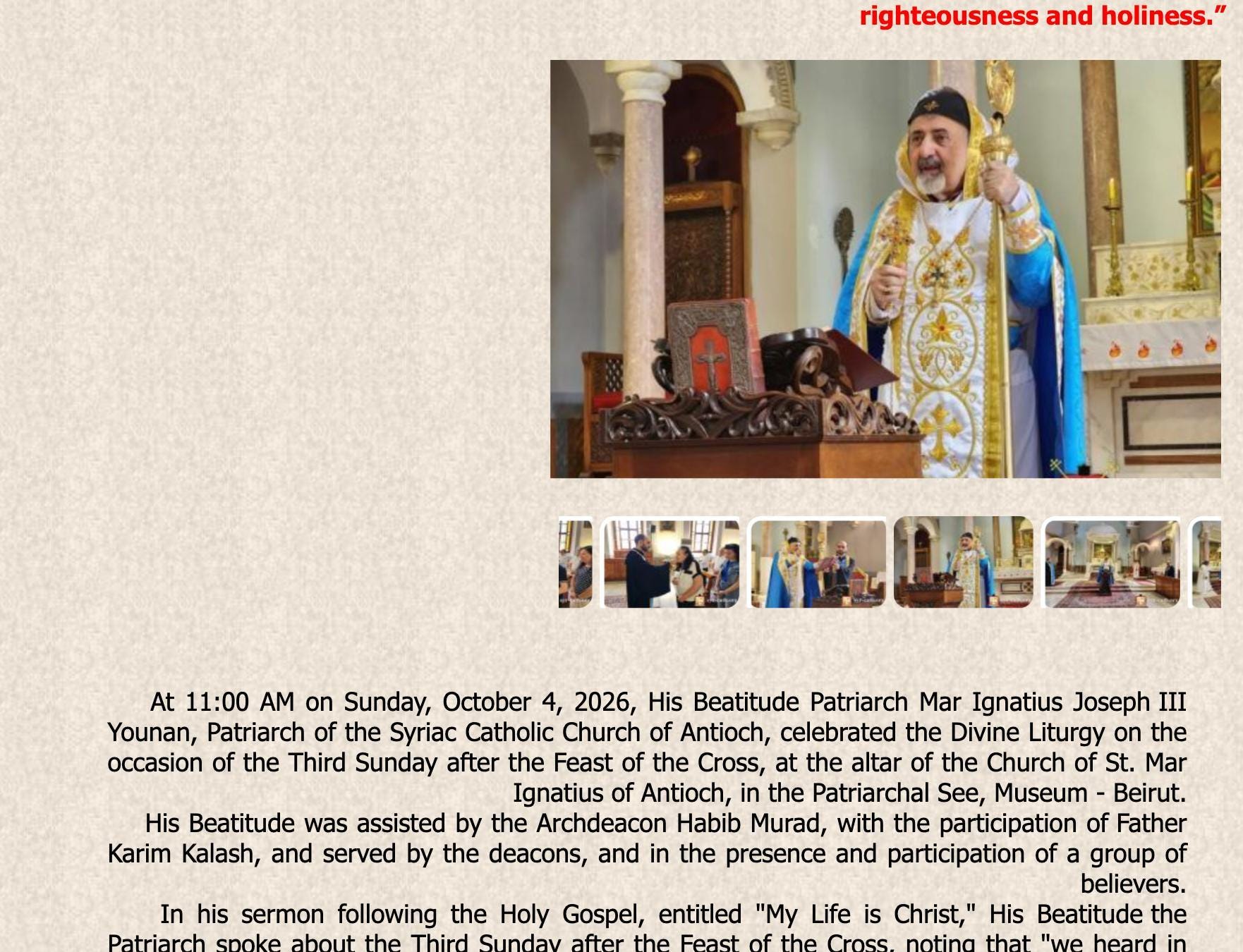
It is not yet clear what occurred at a planned meeting for Syriac Catholic bishops last week, who intended to gather in Beirut and vote to depose their patriarch.
The patriarch himself has not yet responded to requests for comment on the planned meeting from The Pillar.
If he was voted out, the vote would have to be confirmed by Pope Leo.
Meanwhile, the patriarch seems to be continuing with patriarchal duties, and keeping Syriac Catholics updated accordingly:
When we know more, we’ll let you know.
—
And a major Vatican meeting will begin tomorrow, at which leaders from 115 episcopal conferences will be represented, for a discussion about marriage and family ministry, entitled — “Ten years after Amoris laetitia: proclaiming the Gospel with families today.”
Luke Coppen has a breakdown for you of who will be at the meeting, and what’s scheduled.
With the controversial Amoris laetitia in the title, and in the cultural aftermath of the various controversial synods of the Francis papacy, I think a lot of Catholics — and especially those in the media — have been expecting that the meeting of bishops will be a heated affair, a kind of referendum on the contentious AL footnote and everything that came thereafter.
And indeed, there has been a bit of palace intrigue surrounding the meeting. Sources close to its organization have confirmed for The Pillar that while a list of Churchmen was circulated last week as being the personal invitees of the pope — a list including American cardinals Cupich, Tobin, and McElroy — the invitations seem to have come from the Vatican’s synod secretariat, with the co-sponsoring Dicastery for Laity, Marriage, and Family Life learning of the invitations at nearly the same time as the general public.
In short, there are questions about whether Vatican figures like Cardinal Mario Grech, along with participants from Germany and other central European counties, have hoped to see the meeting dive into the controversy by taking an outsized focus on the Francis-era debates about the Church’s theological “paradigm” and her basic teaching and marriage and sexuality.
But Leo’s intention has seemed different — a conversation about why marriage rates are declining precipitously, about how the Church can address early marriage divorce rates, and about the apostolic identity and mission of families themselves.
And organizers from the dicastery side of the block seem to be emphasizing that the meeting will be mostly an exchange of ideas, with little expectation of an end product.
It’s a fair bet that Leo’s opening and closing remarks at the meeting will emphasize that thread — that the idea is some shared discussion about pastoral ministry, that marriage is in crisis and the Church can help, and that — if his prior speeches are any indicator — that all of that will come with fidelity to Church teaching, not its radical reconsideration.
In short, Leo being Leo will mean a preference for the irenic and practical, and little emphasis placed on the sideline conversations calling for radical revisions to the Catechism and the Church’s pastoral practice.
With that said, I do hope something more substantial will come out of the meeting, especially about the call to families to apostolic mission. It is an easy temptation for Catholics to become self-enclosed, for parents to imagine that their children are the mission field, instead of Christians who should be invited to it — the potential protagonists of the Great Commission, not merely its object.
And while many people have gushed about the non-controversial parts of Amoris Laeitia, I’ve not personally understood that, finding the text to be mostly slogans and bromides, without much substance to justify its voluminous length. If this meeting is the start of elaboration on those slogans — and concrete challenges to families — then it might well be an affair worthy of the attention it has received.
Look for Leo’s opening address this week. That will be the hermeneutic key to what the pope himself thinks the meeting is for — and what it isn’t supposed to be about.
Ho Ho Ho
Finally, a ranking leader of the Church of Jesus Christ of Latter Day Saints, a Christian-adjacent American religion, told members of his church on Saturday that “gambling is morally wrong. Gambling is built on the desire to obtain something for nothing. Its structure requires that any gain comes at others’ expense.”
D. Todd Christofferson, second counselor of the LDS Quorum of the Presidency of the Church, told Mormons to avoid predatory gambling apps on their cell phones, including prediction markets like Kalshi and Polymarket.
The Mormon was right.
(As an aside I should note that the LDS church officially discourages use of the term Mormon, preferring that its adherents be referred to as “members of The Church of Jesus Christ of Latter-day Saints.” Unfortunately that doesn’t have the same rhetorical resonance.)
I actually think an occasional bout at the tables in Vegas or Atlantic City is probably a tolerable diversion for Catholics, so long as one isn’t betting his children’s milk money or the mortgage. And I’m not above a lottery ticket when the powerball climbs high enough— and The Pillar should probably buy a ticket right about now.
But I also think that gambling apps are insidious, programmed to take advantage of our neurology in a manipulative way, and that prediction markets are no exception — highbrow tech wrappers for basic bookmaking.
Like social media, pornography, and NYT Connections, the gamified appification of the thing increases its intensity, its ability to make addicts of us, and to lead us inevitably to some precipice of ruin.
Mormons — sorry, Mormon members of The Church of Jesus Christ of Latter-day Saints — will need to begin divesting themselves of their app-based gambling habits, and Catholics — sorry, members of The Church of Jesus Christ of Mary and the Apostles — should probably consider following suit.
For some, this will be hard. But for myself, I’m grateful that of all my many vices, I’ve not fallen deeply down the rabbit holes of wagering.
In fact, I’ve made only one memorable bet in my entire life.
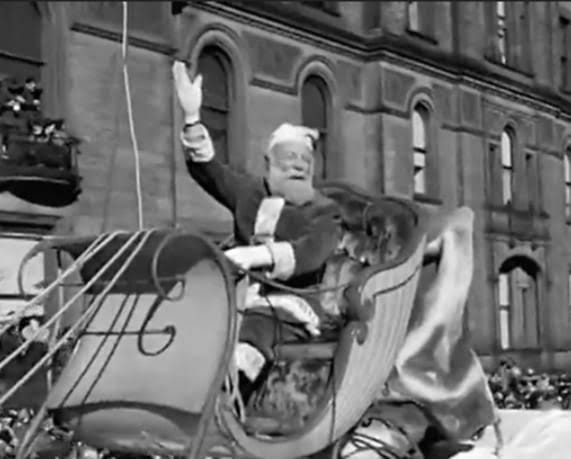
I was seven. I was watching with my dad and sisters the Thanksgiving Day Parade. As the parade came towards its end, my dad asked if we were excited to see Santa Claus.
That was about the most absurd thing I’d ever heard. We were watching the Thanksgiving Day Parade. Christmas was some time away. I hadn’t even made a list yet.
“Dad,” I protested, “that’s about the most absurd thing I’ve ever heard. We are watching the Thanksgiving Day Parade. Christmas is some time away. I haven’t even made a list yet.”
My dad explained that Santa is at the end of the parade because Macy’s wanted to signify the beginning of the Christmas shopping season (which now starts at Labor Day, by the way). He reminded me about “Miracle on 34th Street.”
I hadn’t seen the film, but I was sure it was wrong. I told him so.
In retrospect, my father had probably had enough of his precocious seven-year-old’s unflappable and underserved confidence. We did not yet know that I’d eventually make a living pontificating on podcasts about matters of which I have very little knowledge. It was decades before confident denial of clearly demonstrable facts would become the fundamental basis of the American political process.
My dad just knew he had a little towhead who made it a point to say “well, actually,” some 10 or 12 times a day. And now on the other side of some similar situations, I can well imagine how he felt.
So don’t be surprised that my father decided to teach me a lesson.
“JD,” he asked, “do you want to bet?”
Well, I loved the idea of taking my father’s money, especially when he was so obviously mistaken. I summoned in my mind the most princely sum I could imagine.
“Sure. I’ll bet you 50 bucks that Santa is nowhere near this parade.”