
Pillar paid subscribers can listen to JD read this Pillar Post here: The Pillar TL;DR
Hey everybody,
The DDF has made an important ruling on some much-discussed Marian titles, and you’re reading The Tuesday Pillar Post.
But before I tell you about the ruling, please let me acknowledge that you’re getting this newsletter a bit late, and it’s because I’m traveling right now — you can read about that in just a few paragraphs.
First, let me tell you about Fr. Arnold Damen, SJ.
Fr. Damen was Dutch, he came to the United States with his family, joined the Jesuits, and became a priest in 1844.
He was professor, and then a pastor, and was sent in 1857 to establish a Jesuit presence in Chicago. He founded a parish, Holy Family, on the city’s West Side, which was populated by Irish and other immigrants, who were largely derided by more settled Americans as invaders or freeloaders.
Damen helped them build a church, and then schools, and a small college, right in their own neighborhood.
He was there for more than a decade, growing the parish, and standing with his people. And then in his own parish, in October, 1871, disaster struck.
Though people still disagree, most accounts say the fire started October 8, 1871, in a barn belonging to Catherine O’Leary. Some people say a cow kicked over a lantern. Other people say a woman knocked over that lantern while carrying a case of beer. There are stories that maybe the fire started while a group of men played cards inside the barn, careless with ashes.
But whatever the cause, the barn went up in flames. Then houses caught fire, their tarred roofs exploding, with flame raining down on wooden sidewalks.
Given a bad message, the fire department went to the wrong part of town, while the fire spread to lumber and coal yards, and wind blew burning chunks of tar across the city. Within one day, four square miles had burned. Hundreds were left homeless.
It might have been worse. It might have destroyed Holy Family Church, and even more homes. But Fr. Damen — in New York to preach a parish mission — took to his knees in the parish where he stayed, and promised to Our Lady of Perpetual Help that if she spared his church and his people from more anguish, he would light inside seven candles — to remain always lit as a sign of his devotion and gratitude— at his parish statue of her.
Today, even while we pray for the Blessed Mother’s intercession, we might make fewer of those kind of promises. But they were a devotional practice very common in Fr. Damen’s era, and the real point was that he entrusted his people to Mary’s intercession.
When he returned to Chicago, it was to devastation. But the church had survived, and Fr. Damen lit the candles. Today, electric candles remain lit in the same spot in the same church.
More to the point, Fr. Damen opened the church, the schools, and every building he could to the people made homeless by the fires.
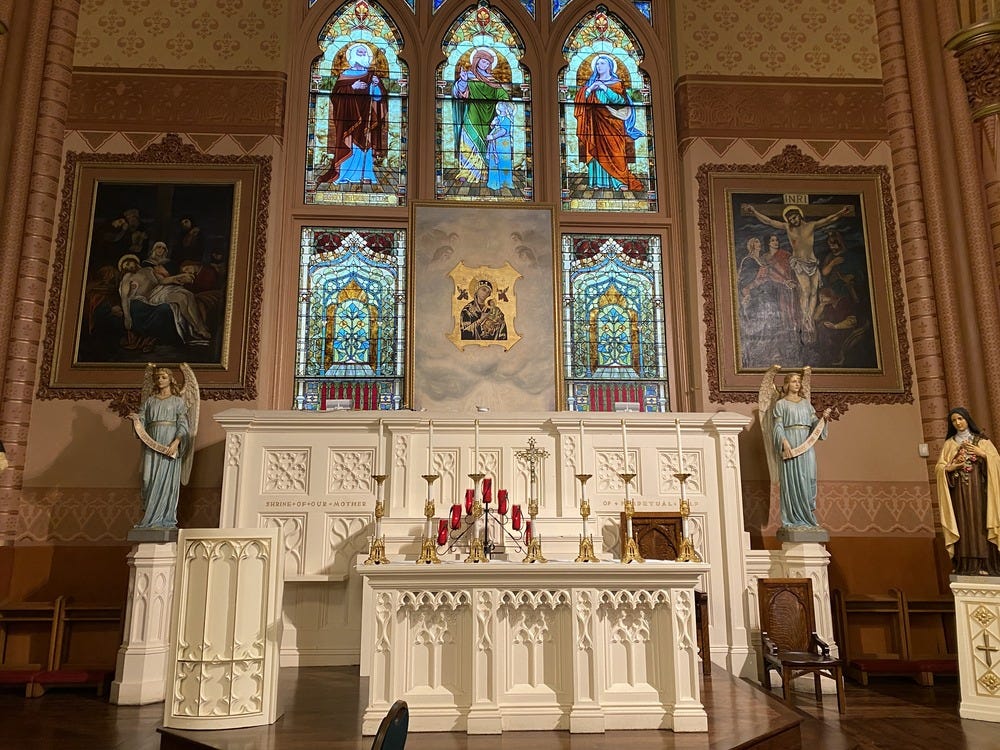
He borrowed money, leveraged what he had, and helped people rebuild.
He did what he could to be in solidarity with his people as they recovered from disaster, as they buried their dead, and as they got up off the mat.
The stroke that eventually killed him came in Wyoming in 1899, as he distributed the Eucharist during a parish mission. He died a few months later.
Fr. Damen is still remembered in Chicago, with a street named for him, and some statues.
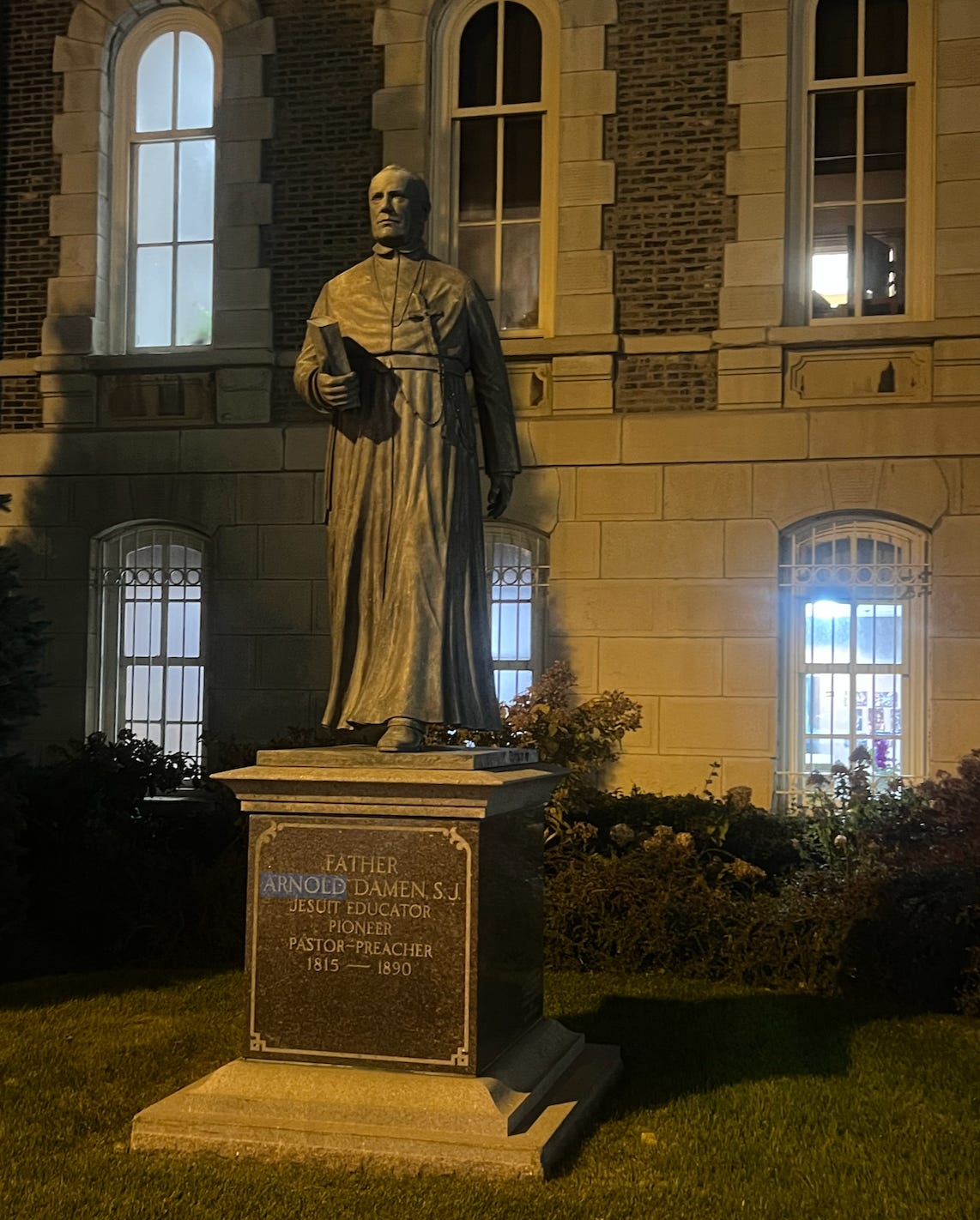
May he rest in perpetual light — and far from the threat of fire!
The news
The Dicastery for the Doctrine of the Faith on Tuesday presented a judgment on two Marian titles which some have hoped would eventually be proclaimed dogmatically: Mary as “co-redemptrix,” and as “mediatrix of all graces.”
The note took seriously, and grappled with, the theological arguments that Mary cooperates in redemption — even in a unique manner — but suggested that the titles should not be used, because they “create confusion and an imbalance in the harmony of the truths of the Christian faith.”
The Pillar talked with Cardinal Victor Fernandez this morning about how the DDF’s doctrinal note came to be — and you can read about that, and what it says, right here.
—
Pope Leo is headed to Lebanon next month, a Leonine add-on to a long-planned papal junket to Turkey.
Lebanon is a complex country: Shaken by months of Israeli bombing in its southern region, parts of which are controlled by the political and militant group Hezbollah, Lebanon is home to one of the largest Christian minorities in the Middle East. But many Christians have fled due to violence and instability in recent years.
So what might Leo say, or hope to accomplish, among the Catholics there?
We talked with the country’s bishops, priests, and lay leaders in Lebanon about exactly that — what might the point of the papal trip be, and can Leo leave an impact?
“We have many Catholic politicians who don’t behave as Catholics and don’t defend Catholics, we have corruption, shortages, everything is expensive, and the political situation worsens by the day while Israeli bombings continue in the south of the country, it’s all very difficult,” one bishop told The Pillar.
“The Church is tired of the situation in Lebanon. I’m certainly tired of the situation,” he added.

This Advent, gather with fellow Catholics for a Bible study unlike any other. Bible Across America is a nationwide Bible study hosted by the St. Paul Center. During this inaugural study, we’ll encounter Christ as “Teacher and Lord,” discovering what this means for our lives as modern-day disciples.
The bishops of Germany had an eventful last week, as Cardinal Reinhard Marx was found in an independent report to have led a diocese marked by inadequate communication with law enforcement on abuse allegations, “old habits of ‘pastoral leniency’” toward perpetrators, and limited concrete assistance toward victims.
The report dealt on the history of abuse in the Diocese of Trier, which Marx led from 2002 until 2007.
At the same time the report made headlines across Germany, the country’s “synodal way” published a school guidelines document, published with a commission involving German bishops, which called for “a re-evaluation of homosexuality in the Magisterium” in both teaching and practice in the Church’s life.
It was, as Luke Coppen reports, a busy couple of days in Deutschland.
—
A Halloween parade in Hanover, Pennsylvania, sparked controversy over the weekend when a local Catholic school’s float included a replica of the main entrance gate at Auschwitz concentration camp, with the notorious phrase Arbeit Macht Frei — “Work will set you free”.
The small-town parade float made international headlines — and they came amid a charged national debate about the growing prevalence of antisemitism in this country.
So from the local bishop’s apology to the artist’s rambling explanation, The Pillar gathered all the fact and explanation which could be had. Here’s what we know.
In recent weeks, rumors have been flying about what eventual new statutes for the prelature might contain — and whether Opus Dei might be split up into several canonically established institutions.
But what’s the real state of affairs? And when will we know more? Read up, right here.
But while Trump says he wants to stand in solidarity with a church facing violence, Nigerian bishops are not in agreement about whether that’s something they actually want. Here’s why.
—
Two columns to note, Pillar readers.
“We all know that some educational institutions…choose to continue reducing education to the vapid, fragmented and complex,” she writes. “Just like some stars die, some educational projects in the Church do not take Christian paideia seriously, and in those cases, dying as an institution — like a star — seems best.”
Keep Hope Alive
After a major fracas, with which Pillar readers are already familiar, Durbin declined the award, and was not honored at last night’s gala.
But during his remarks at the event — attended by more than 400 people — Cupich defended the decision to offer Durbin the award, saying that he hoped it would call Catholics (presumably including Durbin) to a more thorough commitment to Catholic social teaching.
“My hope was that honoring Senator Durbin at this celebration would serve as an invitation to Catholics who fiercely defend the vulnerable on the border between the United States and Mexico to ponder why the Church also defends the vulnerable on the border between life and death, as in cases of abortion and euthanasia,” Cupich said.
“Likewise, it could invite Catholics who tirelessly promote the dignity of the unborn, the elderly, and the sick to extend the circle of protection to immigrants that are facing in this present moment an existential threat to their lives and the lives of their families.”
To a standing ovation, the cardinal insisted that Catholics are not a “one-issue Church.”
Cupich has been criticized for his defense of the Durbin award, but the cardinal insisted that it was meant as the launching point for discussion.
“Total condemnation is not the way forward, for it shuts down discussion. Praise and encouragement can open it up by asking their recipients to consider extending their good work to other areas and issues,” he said.
“More broadly, a positive approach can keep alive the hope that it is worth talking to one another, collaborating with one another to promote the common good. No one wants to engage someone who treats them as a thoroughgoing moral threat to the community.”
You can read about his remarks at the event here.
I heard those remarks live at the Keep Hope Alive event last night — Ed and I bought tickets when Durbin was still slated to receive the award, because we thought we had better go and cover it journalistically. When Durbin withdrew, we decided to attend anyway, because the benefit was the coda to an important national story, and therefore merited coverage.
But I almost didn’t get in at all.
In fact, before I could hear Cupich talk about “dialogue,” I had to spend some time in conversation with the Chicago PD.
—
I arrived at O’Hare Monday afternoon at about 5 p.m., with the Keep Hope Alive benefit set to start at a local Catholic high school one hour later. Ed had already arrived in Chicago, and was champing at the bit to get to the school, where his grandfather’s photo hangs on the wall of the Ignatius Prep Athletic Hall of Fame.
At the airport, I put on a suit, and got in a taxi, for the hour-long ride required to traverse about 10 miles on a Chicago Expressway.
When I arrived, Ed was pacing outside the entrance, awaiting my arrival.
We had, to be clear, purchased tickets for the event weeks earlier. In fact, having expected Durbin to be there and offer remarks, we’d even upgraded our tickets to include the VIP cocktail reception, in the event that’s where Durbin and Cupich might offer their most direct remarks of the evening; we didn’t want to miss it.
We might have requested media access rather than buy tickets off-the-rack, but since the archdiocese hadn’t advertised any way to be credentialed, walking in the front door with ticket in hand seemed the best way to attend the event.
Except it wasn’t.
I met Ed on the sidewalk, we shook hands, and joined the queue of people waiting to be cleared by security and enter the event.
Except that as we got to the interior doors, they slammed shut, with security guards — mostly off-duty Chicago PD — on both sides.
I thought there must have been something wrong with the door, or some confusion over where to enter. But then Ed spotted it. One of the cops, on the inside of the door, was holding a stack of photographs printed from the internet.
And, friends, the top photograph on that pile was me.