Hey everybody,
Today’s the feast of the great Capuchin saint Lawrence of Brindisi, and you’re reading The Tuesday Pillar Post.
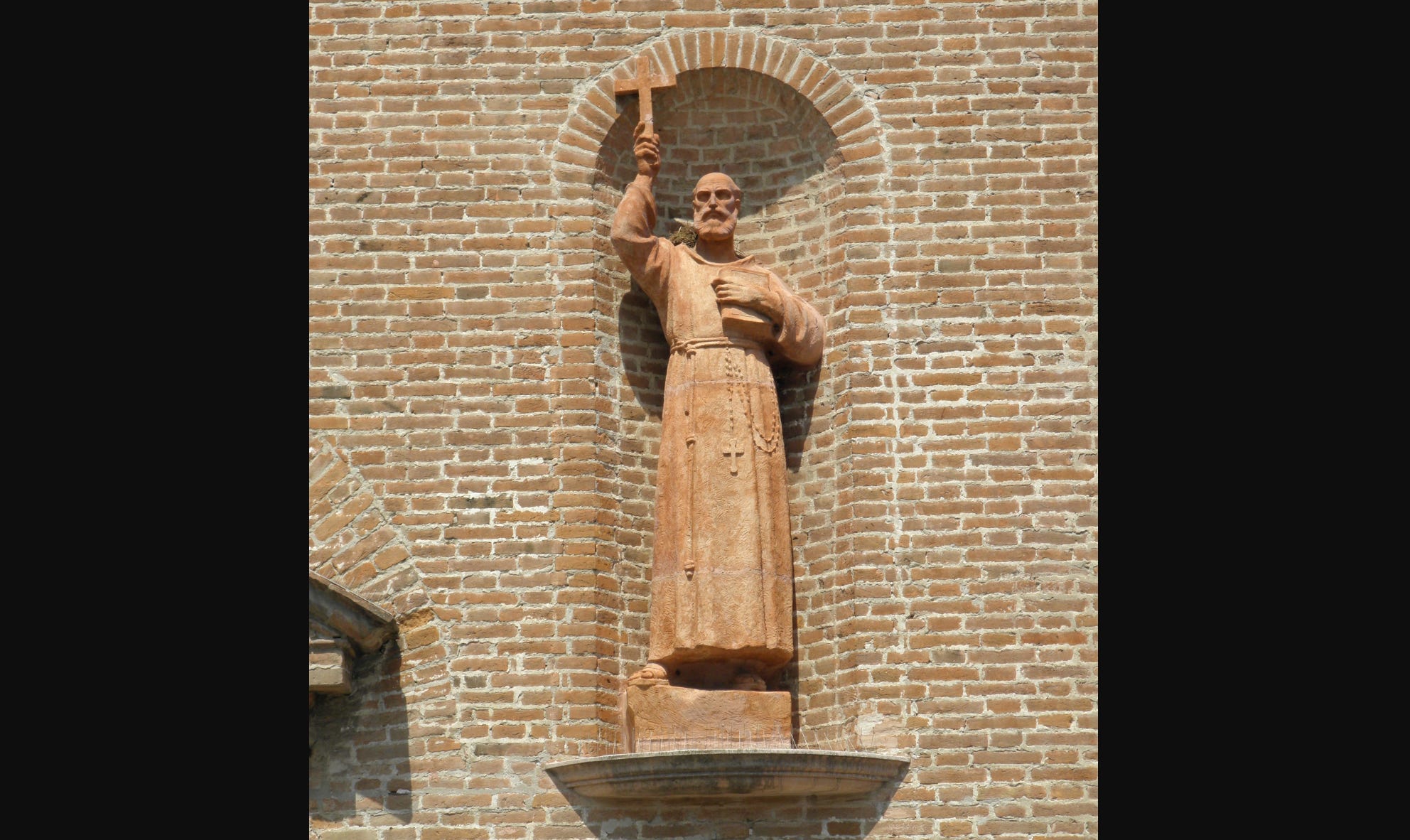
Lawrence — whose baptismal name was Julius Caesar Russo — was born in 1559, and cared for by Conventual Franciscan friars after his father died, when lil’ Julius Caesar was seven.
Despite his unconventional Conventual raisin’, Lawrence became a Capuchin Franciscan in 1575, when he was 16, and then a priest when he was 23.
He was brilliant. Off-the-charts, scary smart.
For a Capuchin, that’s a cool attribute, because it meant that he wouldn’t be cordoned off in academia, but instead commissioned as a preacher, and charged with preaching to ordinary people about their call to holiness, in the wake of the Council of Trent.
He read Greek and Latin and Hebrew and Syriac, and a bunch of modern European languages.
He applied that knowledge to Sacred Scripture, which put him in a good position to preach against the emerging sola scriptura theology of the Reformation using Scripture, though not quite solely, as it were. He drew from rabbinic literature and the Fathers of the Church, and he did it for the practical purpose of helping Catholics stay Catholic when fervent Reformation preachers, and the changing economic landscapes of their countries, often urged them elsewhere.
His biographers say the center of his life was the Mass. And what we have left behind from him are sermons, which I spent a good deal of time perusing this morning. I decided not to excerpt any of them for you because Lawrence’s preaching didn’t lend itself to sound bites — the man preached in ways that built something, instead of just offering some easily extracted pithy phrases. But I encourage you to google him and read some of those sermons for yourself: I liked these, on St. Francis, especially.
There is one quote I will share, from a sermon included in today’s Office of Readings:
“The word of God is a light to the mind and a fire to the will. It enables man to know God and to love him. And for the interior man who lives by the Spirit of God, through grace, it is bread and water, but a bread sweeter than honey and the honeycomb, a water better than wine and milk. For the soul it is a spiritual treasure of merits yielding an abundance of gold and precious stones. Against the hardness of a heart that persists in wrongdoing, it acts as a hammer. Against the world, the flesh and the devil it serves as a sword that destroys all sin.”
We’re in need of Scripture more than we’re in need of near anything, save the sacraments. Most of us leave it on the shelf. We ought to pray with it, and know it, and let it form our hearts — “a sword that destroys all sin.”
—
The news
There’s a lot in the news right now about a distressing emergency situation for a growing number of Americans — the one that seems to come from lettuce, and (mostly?) from Taco Bell. Now if you ask me, expecting to go to Taco Bell and walk away with happy bowels is a fool’s errand even if the lettuce has been cleaned in bleach, but foot traffic at the restaurant chain was down July 17 nearly 19% compared to typical Fridays this year, and the chain will have to think outside the bun, as it were, to calm the quaking stomachs of its shareholders this quarter.
If you’re worried about our growing national epidemic of gastric discomfort, have no fear — Michelle La Rosa has a good list for you of patron saints for digestive woes, along with the cautionary tale of the heretic Arius, a cautionary tale we love an excuse to tell, here at The Pillar.
It’s worth a read, right here — and praying for the intercession of patron saints is better than begging for mercy from the porcelain gods, as the saying goes, I think.
And let me tell you this, because it’s funny.
Michelle spent a bit of time yesterday researching the saints who help with tummy trouble, and eventually, as she googled a raft of related terms, the Google Gemini summary which shows up in search results unbidden these days — like the digital version of Taco Bell’s parasite — began pleading with Michelle that if her stomach was in trouble, she should go to a doctor, instead of looking for additional saints to help her.
Gemini just doesn’t understand. It can’t, in fact. But if you’re in that sort of trouble, these saints have been there before.
—
You’ve read already at The Pillar about the Transalpine Redemptorists, a traditionalist community beginning to espouse sedevacantism and planning to see its founder illicitly consecrated a bishop on Saturday.
There are at least some local Catholics with an attachment to the group, or to the preconciliar liturgical form offered in its chapel. While warning Catholics about the prospect of schism for the group, Bishop Hugh Gilbert, O.S.B., also provided a pastoral accommodation for Catholics who might be tempted or inclined to continue worshiping with the group — he made Mass according to the preconciliar rubrics available every Sunday in a hamlet, offered by priests who have left the community.
So why does this matter to anyone who doesn’t live in a hamlet in northern Scotland? Well, because it signifies an emerging trend, it seems to me, in which pastoral outreach to laity affiliated with communities like the Transalpine Redemptorists or the SSPX is including more availability of the liturgy which is important to them, and in which the Apostolic See seems to be tolerant, and perhaps even supportive, of that mode of pastoral outreach.
In other words, before any Vatican initiative to deal with the tensions heightened in recent years by Traditionis custodes, there are local diocesan initiatives, taken by local diocesan bishops, to respond to the needs of their own Catholics. Now, regional mileage will vary, but that could portend a broader reset to the liturgical conflicts of recent years, in a different tone than the one which preceded it. And eventually Vatican action might end up following the pace and direction of episcopal ministry, rather than directing it.
Bishops are, after all, guardians of tradition, are they not?
Here’s the story from Scotland.
—
Running a ministry shouldn’t mean running yourself ragged. 5 Stones takes on the critical work: marketing, order fulfillment, technology, and customer service, backed by a team that shares your Catholic mission. When God calls you to face giants, He sends help too. Learn more today.
Why did the Italian cardinal make a quick and busy trip to Ukraine? What happened over the four days? And what does the trip say about the current state of the Vatican’s peace mission?
—
In 2026, the Church in the United States saw 9% fewer priestly ordinations than it had 10 years earlier.
According to the best numbers available, 342 men were ordained diocesan priests for U.S. dioceses this year. While that number represents a slight uptick from years prior, it also signifies a decline from a decade prior — in 2016, 376 men were ordained U.S. diocesan priests, about 9% more than this year.
But some dioceses have seen steady or even growing numbers of priestly vocations.
So The Pillar’s budding cub reporter Jack Figge talked with a bunch of bishops and vocations directors across the country about what they think is helpful in encouraging men to discern priesthood.
—
Finally, rumors abounded yesterday that the trial of disgraced Fr. Marko Rupnik is coming to an end, and that Rupnik will not be convicted at the DDF tribunal where he is presently facing a canonical trial.
That led to a firestorm of hot takes and some misinformation on the topic, including one erroneous claim that Rupnik is facing an alleged trial related to alleged violence, and will subsequently face a trial related to abuse. I think the confusion came from some of the ways initial reports on the subject were worded, and some misinterpretation of the original rumors themselves.
In any case, The Pillar did not confirm the rumors that Rupnik’s case is at its end, and its disposition resolved. But it is possible — and canonists have said this for a while — that Rupnik will not be convicted in the canonical trial he’s facing, for reasons that have as much to do with legal standards of evidence as with the question of whether he’s done the horrific crimes he’s said to have done. That’s how trials work.
But the Rupnik trial — given the twists and turns which preceded it, and the sickening allegations against him, and the prior conviction for absolving an accomplice, and the untouchable status the guy seemed to enjoy at the Vatican — has become for a lot of Catholics a referendum on the integrity of the Vatican, and its resolve to actually hold abusers accountable.
It has the highest possible profile, and if Rupnik is not convicted, justice will not be seen by most people to have been done.
I wrote an analysis about some of this, which you can read here.
Here’s what that matters though — those high public stakes should not impact the judges in the case, who have the unenviable task of judging the thing according to the testimony available to them, and in line with the rules of procedure and evidence which govern criminal trials — quod non est in actis, non est in mundo, the saying goes.
Judges who do that are the only thing which can give us any sense that the rule of law is actually operative — and Leo seems intent on restoring that sense in the life of the Church.
At the same time, if Rupnik is not convicted, Pope Leo will almost certainly have to allow far more transparency into the decision and the reasons for it than is typical of the Vatican’s reflexive tendency towards nondisclosure.
And at the same time, the pope will have to decide how to handle Rupnik himself, who is a priest now incardinated in Slovenia. If Rupnik is in any way allowed to continue in ministry in light of what’s already known about him, many people will conclude that there is very little serious about pledges of accountability for Vatican insiders or clerics with powerful friends.
In fact, many people have already concluded that — in light of decisions like the relatively rapid reinstatement of Msgr. Jeff Burrill, formerly of the USCCB — and a seeming admission of tolerance for Rupnik would cause a firestorm of disappointment and discouragement at least on par with what was experienced in the U.S. in 2018, when the McCarrick scandal began.
What happens with Rupnik matters, because people want to trust the Church, and thus want to see her do what seems just, instead of what seems convenient. If she does not appear to do justice, fewer people will be able to trust her claims about the meaning of our lives, and the salvation promised through Christ.
Whatever happens with the case, people will have two questions: What will happen with Rupnik, and what will happen with his liturgical art, whose creation was allegedly instrumentalized for the acts of coercive abuse he is alleged to have committed against religious sisters?
No verdict can come out if Leo is not prepared to answer those questions in a way that tells Catholics he’s serious about addressing moral corruption in the life of the Church. And if the rumors have any basis in fact, he will need to be prepared soon.
—
As long as today’s a feast for guys named “Lawrence of …,” here’s one of my favorite scenes from the best “Lawrence of …” epic, the one set in Arabia.
It is perhaps apropos for the news of the day.
Please be assured of our prayers, and please pray for us. We need it.
Yours in Christ,
JD Flynn
editor-in-chief
The Pillar


JD, was that a reference to "burger king foot lettuce" you snuck in? 🤮
Google advised Michelle that she needed to find a physician instead of saints for tummy trouble. That is a good example of how the results form AI needs to be tempered by human reason.