
Hey everybody,
Today’s the feast of St. Paul of the Cross, and you’re reading The Tuesday Pillar Post.
He was born Paolo Francesco Danei, in the 1690s to parents who lost 10 of their 16 children in infancy, and who moved from town to town to make a living with a series of stores. Death was their constant companion, and the uncertainty of failing businesses, and the faith, which was the fixture of their lives.
At 19, he experienced in prayer a clarity about his life that would drive everything which came after. After the crosses of his childhood, the Lord made clear to him that the Cross — the Passion of Christ — is where he’d find the meaning of his own life, because it’s where he’d find Jesus Christ.
From there, it was finding the path. At 20, he fought in a Venetian Republic war against the Turks. He worked in the family business. He helped an older couple, who offered to leave him their estate. His priest uncle tried to arrange for him a marriage.
But none of those things was it. The Lord was calling him to something else. And at 26, he had a vision in prayer — a religious habit, for a community he should found. A community dedicated to the Passion of Christ. Men who lived in penance, in soliditude and poverty, giving witness to the suffering and death of Jesus Christ.
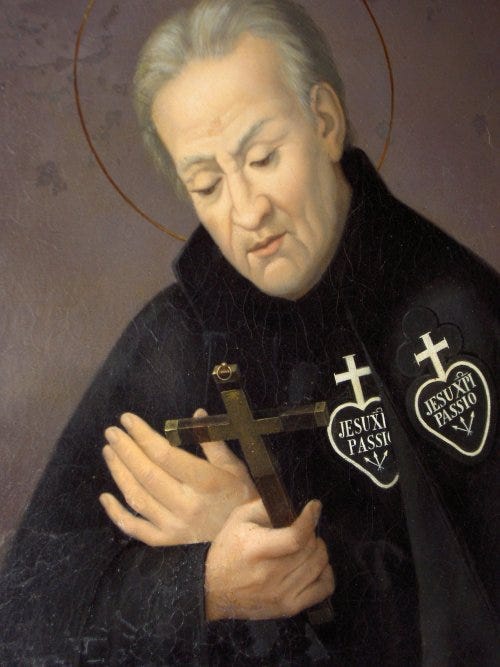
The bishop was supportive. Paul had some benefactors. But he did not have members. At first, only Paul’s brother joined. They were ordained in Rome. They founded a house. But it was a while before more men came, and growth came slowly. These guys lived with austerity, and had no prominence, and spent three hours a day before the Blessed Sacrament. Men who were interested weren’t quick to jump on board.
And Paul was ok with that. He accepted that his life would be a slow witness to joy in the Cross of Jesus Christ. The few men – becoming eventually six, and then nine – preached and gave parish missions. They heard confessions. They were spiritual directors. Over time, they grew even more. By the time Paul died at 81, there were 180 men in his community, preaching and living the cross across the Papal States.
—
I got married at the parish of the St. Paul of the Cross. Before I met my wife, I’d not even heard of him. But I have a kinship with him, and I’ll tell you why.
After Kate and I dated for a while — about two years, actually — I started to feel the pangs of vocational crisis.
I was a young, red-blooded Catholic American male, and I had never seriously considered priesthood. I started to get the nagging sense that meant I had done the Lord wrong. The sense turned into guilt, and — before I knew it — I’d come to believe that I wasn’t really loving God unless I would love him as a priest.
I needed to apply for seminary. I told Kate. She, lovingly, called me an idiot. She told me that’s not how God speaks to us. She told me the Lord doesn’t call us through guilt, or fear. And she was right, of course. But at the time I couldn’t see it.
She told me she’d give me a little time to figure myself out, but she wouldn’t take my call forever. Smart girl.
So we broke up. I spent a few dismal weeks feeling depressed. I called my diocesan vocations director and left a couple of messages. (As it happened, he didn’t call back with alacrity).
I was young — maybe 21, then, or 22 — and in the rental house where I lived with some pals, we didn’t have much furniture. In fact I slept on an air mattress. But some time in that dark period, it got a hole, and a slow leak. Each night, I filled the mattress up. Each morning, I woke up on the floor, ensconced in a wheezing and sputtering rubber raft.
I was too depressed to do much about it. It was, probably, a perfect metaphor.
But somehow, I thought, that was what God wanted.
Then I made a silent Ignatian retreat. I’m not good at silence. I couldn’t chat with the other retreatants, who were all stern-faced and more serious than me. So I’d sneak out the service doors at night, to bum cigarettes and stilted Spanish small talk from the kitchen workers and custodians.
And while there are very few times in my life when I can say the Lord has spoken to me with a clear and unmistakable voice – with undeniable clarity – that retreat was one of them.
It was the Ignatian meditation on the cross. I won’t forget. I knelt in a sun-dappled chapel before the crucifix, and I heard the Lord speak to me.
The meaning of my life would be the Cross, he said. The joy of my life would be the Cross. And I should share that life with Kate.
—
Well, she took me back. And it wasn’t too long after that we got married, on a January evening, under a stained glass window of ole St. Paolo Francesco. I like to think he’d been interceding for us all that time.
Anyway, here’s the news.
The news
Last week, the papally-convened Amoris laetitia summit was overshadowed by news of Pope Leo’s lung cancer diagnosis. But the participants in the meeting say it was a conversation worth having.
And when it concluded, our own Edgar Beltran talked with a lot of them, to get a sense of how the meeting went, in their own words.
In closing arguments last week, prosecutors said that the Tarnow diocese only reported allegations of child abuse to the police after they were made public in a blog post. The bishop’s defense team argued that it was not clear whether the bishop actually had a legal obligation to report the allegations in question, and should thus be acquitted.
Some observers in the country have charged that Bishop Jez is facing a kind of political persecution, while others — including many safeguarding advocates — have a more critical view of the bishop’s decision.
In Poland, the case is a big deal. And it’s worth watching anywhere in the world, especially to see how the Holy See acts when the criminal case is concluded.

The Reverent Liturgy Project gathers the wisdom of priests who have successfully adopted classically Catholic worship practices and offers it to priests searching for ways to make their parish liturgy more beautiful and reverent. Join Archbishop Cordileone & the Reverent Liturgy Project at reverentliturgy.org to set souls on fire for Christ.
In short, Ireland held a synod, and the majority of participants urged the Church to focus on transmitting the Catholic faith to young people. In a country with spiraling levels of Catholic practice, that makes sense to me.
—
Parishioners of St. Andrew in Riverton, Utah are aiming to build a new kind of parish campus, and a basilica-style church, in one of the largest walkable, mixed-use developments in the United States.
With mixed-use developments on the rise in the United States, the model being pursued by St. Andrew’s could be a new paradigm in parish campus designs, one in which a “set of magnetic spaces…draw people in based on normal human desire, and then awaken the desire for higher and higher, deeper and deeper things within sight of the object of that desire.”
(Not mentioned in the story, but a point worth knowing, is how close the new parish is to the home stadium of the Utah Bees, where I have enjoyed twilight AAA baseball in the company of some truly excellent Pillar readers.)
While the guidelines are significantly more robust than those offered by dioceses in the United States, the Swiss bishops told The Pillar Friday that AI was used “intentionally” in their production.
—
And here’s something beautiful from Simcha Fisher, which I am very proud to publish at The Pillar. I needn’t say more — you should just read it.
By the way, it’s paying subscribers like you who make it possible for us to publish great stuff like this. If you read it, you should subscribe:
Finally, two things in the news right now that you haven’t yet read about at The Pillar.
First, it was widely reported yesterday that Archbishop James Golka of Denver had obliged popular spiritual warfare priest Fr. Chad Ripperger to a year of silence.
That led to a great deal of controversy, since Ripperger is a figure of internet notoriety — either famous and infamous, depending on which twitter.com accounts you read.
The archdiocese released a statement indicating that the decision was a mutual one:
Archbishop Golka recently met with Fr. Chad Ripperger to discuss his ministry and his community, the Society of the Most Sorrowful Mother. During that conversation, the Archbishop asked Fr. Ripperger to consider a one-year fast from public speaking and interviews. The time will allow him to devote himself to the Society and to the people it serves. Fr. Ripperger readily agreed. At the end of the year, they will review the arrangement together.
Archbishop Golka is grateful for Fr. Ripperger’s priestly service, exorcism ministry, and for the generous spirit in which he received this request. We ask the faithful to join us in praying for Fr. Ripperger and for the Society.
But I was not at all surprised to read reactions which basically flagged Golka as some kind of Satan-tolerating liberal, who was unjustly suppressing both an enemy of demons and a Patron of Tradition. Nor was I surprised to read the takes which had Golka as a hero, for finally shutting down a priest framed as the darling of the toxically gigachad-MAGA-incel universe.
Thing is, neither of those takes are right. What’s true is that Golka inherited the celebrity Ripperger from his predecessor, and is the kind of person who likes to proceed with careful thought, deliberation, and (by all accounts) prayer. It’s not surprising that his first approach to any challenging issue would be to urge everyone involved to a period of prayer (which involves some stepping back) before deliberation or discussion. In fact, my contacts in the Denver chancery say that’s how the archbishop handles a great many issues — not quick on the draw, trying instead to take time for the Lord to speak before making decisions.
The point is that I wouldn’t read into this any kind of final deliberation about Ripperger’s future in the Archdiocese of Denver, or a clear indication of what Golka might intend for the limitations of his public ministry.
But I do think, as usual, that the yen to read the whole thing through our preconceived ideological lenses should be a reminder to, you know, not do that.
—
Speaking of which:
Many of you have asked me about a recently published column from the Bishop of Knoxville, Tennessee — a diocese with which I am known to have some familiarity.
In the column, Bishop Mark Beckman announces a decision to see East Tennessee parishes “move away from additional prayers recited together immediately before, during, and immediately after Mass.”
Those prayers most notably include the St. Michael prayer, which was in 2018 implemented at the conclusion of Masses in Knoxville by Bishop Rick Stika, in hope of seeking the Lord’s intervention into the sexual abuse crisis roiling the Church.
I don’t have a take on Bishop Beckman’s decision, because I don’t yet know enough. So I emailed the diocese yesterday.