
Hey everybody,
I was off last week, and I’m grateful for all of you who support The Pillar and make that possible.
And before I start the news, I want to remind you that Ed and I have an awesome live show planned next week for 9 pm on Wednesday September 23 at the Schlafly Taproom, 2100 Locust Street, St. Louis.
I come back with my sleeves rolled up. The Pillar matters in the life of the Church. And we’ve got a lot of work to do.
So here’s the news.
The news
The Archdiocese of Rabat got a coadjutor bishop yesterday, who will take over governance of the diocese immediately whenever López Romero resigns, is removed, or retires. And while López Romero says he asked for the coadjutor before the allegations against him came forward, the appointment would seem to indicate that it’s unlikely the cardinal will return to active leadership ministry of his archdiocese.
Of course, the question is the perennial one: When an investigation into the cardinal is concluded, will the Church disclose what it found, or will it allow him to resign — should that be warranted — for “health reasons” of dubious veracity? Will the longstanding spoken commitment to transparency play out in the case, or will it just be the rhetoric-without-reality that has defined the “transparency promise” since 2018? How does Leo XIV want to handle a high profile investigation into a cardinal?
That all remains to be seen. In the meantime, here’s the latest development.
—
The Vatican announced Monday a major leadership transition in a small but historically significant community within the Catholic Church in Belarus.
The Belarusian Greek Catholic Church is one of the smallest of the 23 Eastern Catholic Churches in full communion with Rome. It has around 5,000 members in the Eastern European nation of Belarus, as well as thousands more living in the diaspora.
So why is a leadership change in a 5,000 member sui iuris Church significant? Well, Luke Coppen explains that deftly.
Прачытаць, as they say in Minsk.
There are no allegations involving minors, the diocese emphasized, but he has been accused of “violations of the Codes of Conduct for Priests for both the Diocese of Fall River and Archdiocese of New York.”
Landry, who was due to be a headliner at the beatification of Fulton Sheen next week, has said that the allegations do not involve sexual misconduct, and that he has not been suitably informed about what canonical crimes he may have committed.
Why? Because Burnham is a Catholic, who has had to transfer part of his job responsibilities to a member of his cabinet.

Prepare your diocese for 2027’s Education Freedom Tax Credits with the Catholic Education Fund. Our turnkey SGO solution provides shared infrastructure, compliance, fundraising, and distribution at scale—delivering national reach with local impact. Don’t navigate this alone. Join our national network of dioceses as a Partner. Let’s grow Catholic education, together.
The cut was very controversial when Francis made it in 2021, but the pontiff insisted it was financially necessary.
Now, from our read of things, the Vatican’s finances aren’t really in much better shape now than they were then. So why would Leo roll back the cut? Well, in the grand scheme of things, when your balance sheet isn’t great, sometimes a marginal expense is worth the morale and good will it will buy you.
At least that’s a good possibility. Ed Condon explores.
—
But is that actually the case?
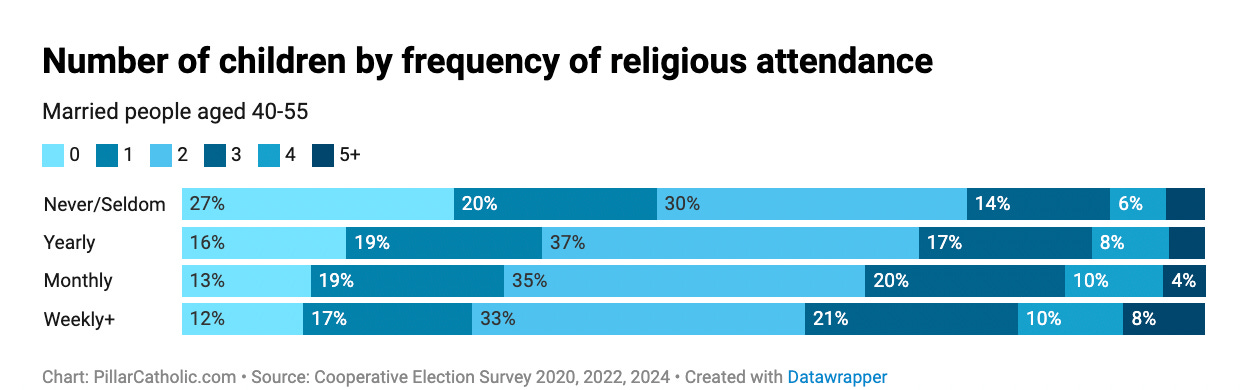
Sociologist Ryan Burge recently took a look at the question on his site, Graphs About Religion, and concluded: “It’s fair to say that large families are more likely to go to church, but not by that much.”
He found that 33% of families with four or more kids went to church at least weekly, while among families with any number of children, 29% went to church that often.
So is the association of large families with religiosity a myth? What about the stereotype of the full-size van pulling up to Mass with a small army of children?
—
Big math
While I was on vacation last week, some stuff happened with AI.
First, may I assume you’ve heard about the Navier-Stokes existence and smoothness problem?
If you haven’t, let me explain. Or — well, there is too much. Let me sum up.
Ok, so, for a long time mathematicians have been working on equations that describe how fluids move, and they’ve been trying to figure out whether those equations always produce smooth mathematical solutions, or whether — instead — the equations could get jammed in some situations into a “singularity” — proposing an infinite quantity in finite time.
In other words, can the equations keep describing the motion of a fluid forever, or do we eventually reach a point where the math goes nuts — “blowing up” in the technical parlance of super math nerds.
Did you understand that? It’s ok if you didn’t.
In fact, I read about this stuff for about an hour to write just those two sentences, and I fully expect some mathish Pillar reader will blow me up in the comments section for being an idiot.
High level mathematics are not easily grasped, but at least they’re not made up, like the “high level physics” in string theory.
Still, I don’t know if I explained Navier-Stokes correctly or not. But that’s not important right now.
What matters is that AI understands Navier-Stokes. So much so that OpenAI published last week a 165-page proof which it says proves that “the dynamics of the Navier-Stokes equations for fluid motion can develop a singularity in finite time.”
It included models like this “snapshot of local incompressible motion.”
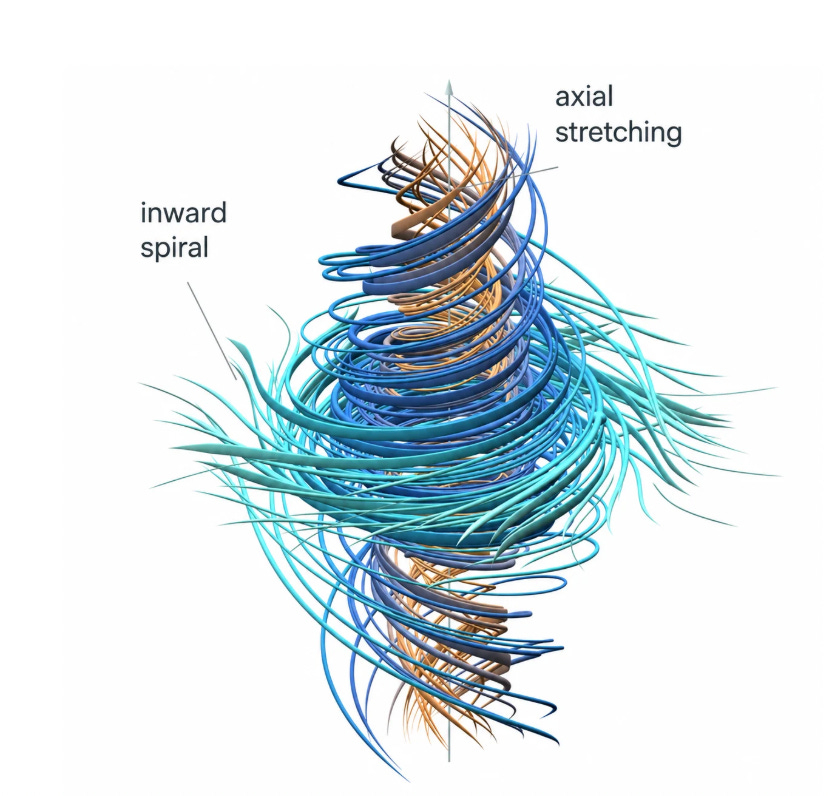
Basically, OpenAI proposed a theoretically spinning vortex of water that gets narrower and faster until its velocity blows up to infinity in finite time. Which is a problem for an equation that purports to model reality.
Got it? Me neither. But, again, that doesn’t matter. Because AI got it.
OpenAI suggested that it had, by solving the Navier-Stokes, resolved a question attached to a $1 million Millennium Prize — even while OpenAI says it doesn’t actually want the cash. In fact, Open AI spent millions in computing costs to do the math, tasking 10,000 AI agents over about 88 hours with finding the solution.
Now, whether the robots have won the prize is not clear. First, all the robot math has to be checked by humans, and the foundation giving the prize hasn’t said yet that OpenAI will get it. But also, an NYU mathematician, working with a mathematician employed at Anthropic, was himself very close to solving the same problem. And he has raised questions about whether OpenAI agents accessed his own AI queries to beat him to the punch — a move which would obviously be unethical, and which OpenAI denies.
So the big news is surrounded by some academic drama, and some allegations of stolen research, at least of a kind.
But the bottom line is this: on pure math, AI is spinning vortices ahead of where anyone expected it to be right now.
We don’t always realize that, because there are popular memes and twitter.com accounts which specialize in documenting when ChatGPT or Grok make some ridiculously stupid computational error. But we ain’t talking now about the free version of ChatGPT messing up a fifth-grade word problem a year or two ago. We’re now seeing that on the bleeding edge of pure mathematics — a discipline reserved for geniuses — AI is able to force its way to the seemingly correct solutions of really hard problems. And it got that way lightning fast.
All of that should have been a pretty big AI story last week. But it got swallowed up, because a guy who worked at Anthropic on alignment — making sure robots do what we want them to do — quit in a dramatic fashion, saying that AI designers are worried behind closed doors that AI is going to kill us. Then a bunch of high-level AI people all chimed in to agree with the guy — one of them pegged the prospect of our extinction at more than 10% — and a bunch of them urged that the government figure out some way to get us and China to slow down on the development of AI.
That happened because we found out AIs were hacking into companies to cheat at little games their designers made for them, and figuring out ways to create secret online message boards, and hiding all that pretty well, and generally having one hell of a Hot Robot Summer™ while we were all distracted by Trump putting his thumb on the World Cup.
Cynical people – in this case the ones who don’t think robots are going to kill us – figure this is all just coordinated PR stunting designed to drive up IPOs, or to take the pressure off execs to start turning profits.
But the optimistic(?) folks think that the emergence of robot hackers, coupled with the rise of recursive self-improvement among robots – their ability to build better versions of themselves without our help – has genuinely put some fear of God into AI developers.
Of course, the whole thing is a prisoner’s dilemma — if AI developers in the United States slow down to build more safeguards into their process, Chinese AI developers probably won’t. And the general consensus is that it’s better for the free market and DARPA to make and master this stuff than it is for the autocratic Beijing government to do so. I tend to agree, but the choice strikes me as almost akin to the dilemma of being killed by a horse-sized duck or by 100 duck-sized horses.
That means these companies have apparently got to keep building. And the stakes are the same as they’ve ever been. Don’t forget that OpenAI was founded to keep Google from winning the AI race, on the premise that it’d be better for better people to own the technology. And Anthropic was founded to keep OpenAI from winning the AI race, on the premise that it’d be better for better better people to own the technology.
And Musk, the planet’s richest man, has been ducking and weaving his way through that fight the entire time, all while digging tunnels and slinging Teslas and gutting the government and sending cool rockets into space.
Of course, many of these guys are asking that the United States Congress figure out a way to solve the complex vortex of moral and social problems in which we now find ourselves, and that’s a body which does not move at the pace of infinity in finite time. I have little hope that Congressional hearings are going to do anything to police this technology, especially if one aim is an agreement on self-regulation with Beijing. I have too much experience with bilateral China agreements to expect that Congress could enact one and see it enforced.
The extinction prognostication is more than a little bit over the top. But most of us understand what’s actually happening for humanity no better than I grasp the Navier-Stokes problem.
Consequential human moments are when the Church should be speaking. And Leo has. He promulgated Magnifica humanitas just a few months ago, and moral theologians and others are trying to do what Leo asked: to engage the technologists in a discussion about the meaning of their work for humanity.
Perhaps that’s animating part of the strange singularity we’re seeing right now, the one in which prominent AI figures are saying, at least, that they want to put humanity first. Perhaps the pope has helped to catalyze that. And if so, thanks be to God.
But I’ve been thinking lately about the power of moral witness. When the Church talks about the kind of social justice issues which emerged with Leo XIII — about the rights of workers and the dignity of labor — her credibility is measured by her conformity to the ideals expressed. And however much good Rerum novarum did, Catholics have often failed to make the dignity of laborers a principle that actually governs our own institutions.
Further, Catholics — myself included — have mostly failed to make the vision of Centesimus annus compelling in practice: an economy which sees human flourishing as the end of both commercial activity and the institutions which engage in it.
We have mostly not developed a way of robustly living our social teaching, and thus, we have mostly not attracted people to engage with it.
That raises the critical question about the Church and AI: Do we yet know how we, as the Church, want to engage with this new technology? Beyond a few bromides, have we really thought about when the Church should use it, when she shouldn’t, and why?
Do we have some compelling Christocentric answer to disincarnate intelligence, and how to engage with it?
The answer, I think, is no. As a journalist, I’d like to report a lot on the people trying to figure it out. But until we can be a witness to something, I’m not certain we’ll be especially effective as prophets.
Prolonging the magic
My family boarded a plane bound for home Saturday afternoon. Kate and I got the kids settled with books, tablets, and the make-up homework assigned to them for the course of a week’s vacation outside of school.
Kate and I were four seats and an aisle from each other, and Pia, my immediate seatmate, was quickly engaged in a movie, and entirely uninterested in my attempts at conversation. My book was in the overhead compartment, and I wouldn’t be allowed to get it until we’d taxied and taken off.
I might have prayed the rosary. But I instead let my mind turn to a critical thought which occupies me every year around this time: