
Pillar paid subscribers can listen to JD read this Pillar Post here: The Pillar TL;DR
Hey everybody,
Two things can be true at once.
Take Tibet.
Tibetan people have a litany of legitimate grievances against the Chinese Communist Party, and Beijing’s human rights record in Tibet is deeply troubling, especially where freedom of religion, culture, speech, and conscience are concerned. There are ample reports of forced labor and labor trafficking from Tibet, and claims of forced sterilization and abortion in the region. These days, issues arise under Beijing’s plan for a “sinicization” of China’s peripheral territories, especially those populated by ethnic minorities.
But Tibet is not the one-dimensional Shangri-la it’s sometimes painted as by its Hollywood advocates, a magical land where gurus exist on a higher plane, waiting around to dispense wisdom one koan at a time to recently divorced Westerners making a spirit quest tour of its finest yurts.
Tibet is a real place, the center for a major branch of Buddhism, and apart from the killer scenery, the flags, and its propensity for yak meat, it has a complex and not-alogether-peaceful history, including an ironically violent history for religious minorities.
And that history brings me to Fr. Maurice Tornay.
He was an Augustinan canon — not the Pope Leo kind of Augustinian, but a different branch of the extended family — who left Switzerland in 1936 as a seminarian with a bit of dental and medical training, en route to the missions in China.
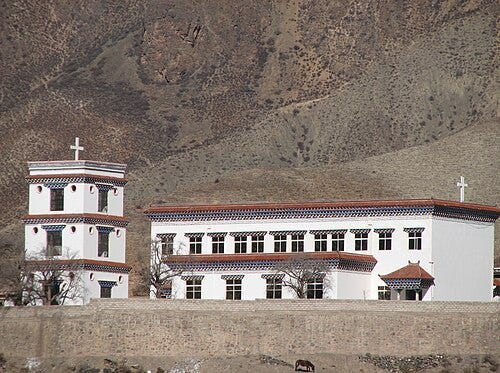
He was ordained a priest in Hanoi in 1938, spent seven years teaching seminarians in China, and then was made a parish pastor at a village high in the mountains of southern Tibet — then the only parish in the country.
Well, the local Tibetan Buddhist monks were no fans of the parish. They didn’t appreciate the incursion of Westernism, as they saw it. (Christianity is in fact an Asian religion, but that was a distinction they seemingly failed to make.)
They also didn’t appreciate that Christianity seemed to threaten their social status atop rigidly hierarchical Tibetan structures, and the economic consequences of that threat. And perhaps some of them — though I really don’t know — genuinely believed that Christianity would lead people astray from the world’s cosmology as they understood it, and the necessary path to truth which that demanded.
But for all the reasons, Catholicism was unwelcome in much of Tibet. Violently so. In fact, in the late 1800s, bandits acting at the behest of those local monks reportedly killed several priests in the region, and destroyed several parishes. In the early 1900s, monks themselves slaughtered Tibetan Catholics and killed their pastor, Fr. André Soulié, along with another priest.
Violence against Christians was still a problem in 1945, when Fr. Maurice became pastor of Sacred Heart Church in Yerkalo.
The next year, monks broke into his rectory, occupied his church, and forced him into hiding. He lived in Parme, China, reportedly with an old peasant, an alcoholic, and the only person willing to take him in.
Months outside Tibet turned into years. Fr. Maurice learned that his parishioners had been forbidden from gathering together to pray, and that some had faced torture, because they would not apostasize.
He sent them messages of encouragement, and he asked Rome to help him, but no one was sure what could be done.
Finally, Fr. Maurice decided he wouldn’t wait any longer. He would go to see the ruler of Tibet, the Dalai Lama, in the capital of Lhasa.
To get there, he shaved his beard, dressed like a Tibetan, and joined a caravan of merchants, traveling with a Tibetan companion. He kept his head down, and tried to fit in. It was some real Obi-Wan type stuff, if you ask me.
But eventually, he was found out. Someone recognized him. And armed men tried to force him back out of the country.
Fr. Maurice kept going. But before he could get to the Dalai Lama, monks grabbed him, and pulled him into the Tothong forest. His last words, people say, were simple: “Don’t shoot. Let’s talk instead.”
But they did shoot. Fr. Maurice and his companion died there in the Tibetan mountains, on August 11, 1949.
He was beatified by Pope John Paul II in 1993.
Slogans aside, if Tibet will ever know real freedom — the freedom that comes through Jesus Christ, not through ideology — I suspect it will be through his intercession.
The news
Well, it’s the August doldrums, which means things are slow in Rome, but there’s nevertheless news out of Italy for you. And for some Pillar readers, it’s the kind of news you most enjoy — Freemasonry news.
Ok, so Freemasonry officials in Italy announced that two recently deceased Italian men, one of some celebrity, were members of a Masonic lodge. That announcement caused a problem, because both men had funeral Masses scheduled in their dioceses. And that meant their diocesan bishops felt obliged to intervene, and to see the funerals canceled.
Why?
Well, because the Church in Italy has been taking pains in recent years to make clear that it remains a very serious canonical crime — and a moral issue for the matter — for Catholics to join Masonic lodges. And they’re not the only bishops trying to emphasize that.
It is not entirely clear what caused the mass border crossing. The vast majority of the undocumented migrants returned to Morocco after Spanish authorities made it clear that they would not be permitted to stay. But the crisis sent the Spanish religious and political worlds into turmoil, with some in the Church – including the president of the bishops’ conference – calling the crisis an “invasion,” while others focused on the humanitarian response.
So The Pillar spoke with Archbishop Emilio Rocha, OFM, of Tangier about the unexpected mass exodus and return of people, the situation on the ground in Morocco now, and the broader situation surrounding migration in the region.
This is the kind of insightful conversation you’ll only read at The Pillar. It’s what we do. (And if you like, you can read it right here in Spanish.)

You are called to grow in your Faith and to evangelize. Deepen your understanding of the biblical roots of Catholicism and confidently share your Faith with others by becoming a St. Paul Center Member. Encounter Christ. Share Christ. Visit https://stpaulcenter.com/memberships to get started for free.
While some experts say the letter is a pointed political move focused on a singular situation, it has prompted fierce debate about the state of the Church, the role of missionaries, and the Church’s response to the nation’s government.
This story is a lot more complicated than you might expect. And it points to the very broad range of cultures in which the Church proclaims and lives the Gospel. It’s worth reading.
—
When you think about the Church in Germany, you think about, like most of us do, the synodal path, the doctrinal tomfoolery, and the evermore acute clashes with Rome.
You might not think about a surfing apostolate. But actually, German Catholics have those, too.
This is a truly terrible story, but it’s not a surprising one to Pillar readers — it involves a cleric who made use of some kind of location-based hookup technology, and made use of it to attempt sexual contact with a minor.
It’s all the more disturbing in this case because the cleric in question has been recognized as teacher-of-the-year in a Catholic high school, where his record of service is surely now undergoing close scrutiny.
So what happens now? When will he be laicized, for example? You can read the details here.
And please allow me to say something I’ve now said many times — since 2021, The Pillar has warned that location-based hookup apps are a very serious danger, used frequently to exploit minors, and criminally. We’ve warned that there is evidence they’ve been used in many corners of the Church, including the Vatican, and that even if a person has no intention of contacting a minor — as this deacon almost certainly did — it can happen anyway, because minors use the apps, most of which do not externally verify their ages.
Those warnings are true, even if we messengers have been frequently candidates for cancelation, so to speak, just for bothering to speak patently obvious truths on the subject.
We’ve also warned that dioceses need strong technology policies to attempt to deter their possible use, but that the most important thing is initial and ongoing screening and formation of candidates to holy orders, and those who have been admitted to holy orders.
Those things also remain true, and yet, I also know that no policy or formation or screening is or will be enough.
I’m not sure what the answer is, but I never want to report on a story like this again, because I never want something like this to happen again. And yet I feel morally certain that it will happen again, and I know that the reporting is of immense importance, to serve as an ongoing call to holiness, and to ensure that perpetrators face real accountability.
The technology we possess is immensely dangerous because — for whatever good it does — it also enables every possible temptation to vice, and it encourages those temptations, and in some cases renders them more demanding.
We’ve built a world where we expect to be able to order up even the most vile temptations with a couple of swipes, and the Church must now form people to live in that world with purity of heart and deep awareness of their own temptations. We are only beginning to unpack the moral and anthropological repercussions of the mortal sin machines we carry in our pockets. I do not mean to be alarmist, but we have already unleashed technology over which a great many people have almost no control, and confessors can tell you well the degree to which that is decimating families, and relationships, and hearts.
And I know that whenever something like this occurs, the response of the Church should be penance and mortification, offered for all those harmed by the scourge of abuse, which can have devastating life-long consequences. May God have mercy on those who might exploit people who are innocent or vulnerable, and thus closest to the Lord’s own heart.
There are few ways to look at the rising number of adult baptisms. One is that there are effective evangelical initiatives and movements in Germany, bearing fruit. The other is that the numbers are perhaps confirmation of the reported trends toward adult confirmations around the world. But another lens is that with fewer infants baptized in the country, it’s reasonable to expect a certain number of people who have encountered Christ as adults, and might not have been in need of baptism if infant numbers were holding strong over recent decades. Those things are not mutually exclusive, and are lenses best understood in synthesis with each other.
Still, the numbers are of a piece with apparent trends in other European countries, and we’re working now on the kind of good reporting which might help the Church to make sense of the numbers.
Going mufti
You can read in the newspaper this morning a story about President Donald Trump being ferried clandestinely out of a summit in Turkey last month, amid threats from Iran against the president and his plane.
As the plane sat on the tarmac, the president was snuck out of the Air Force One he’d boarded, hidden in a catering container which had been lifted to the side of the plane. Once he was secure inside the container, Trump was taken to a military cargo plane, which took him safely to Great Britain, his original plane — packed with the White House Press Corps — serving as a decoy.
It’s worth noting that technically whatever plane the president boards uses the call sign designation Air Force One — and the container might have been entitled to it, too — but I suspect the main presidential aircraft used it for the duration of the decoy flight, to keep Iranian would-be attackers in the dark.
Whatever you think of Trump, it’s fun to read about some cool cloak-and-dagger ruses involving a sitting president, especially if he’s being ferried from plane to plane inside a plain old catering container, sitting next to heaps of “snack mix” or whatever.
But Trump’s covert adventure got me thinking about the propensity of modern popes to sneak out of St. Peter’s from time to time— Pope Francis and John XXIII dressed in black clerics to meet with the homeless, to make sick calls, or (supposedly) to grab a cocktail; Pope St. John Paul II sneaking past his guard detail to get in some skiing; Pius XII reportedly visiting Jewish ghettoes in the habit of a religious; Pius IX fleeing the Vatican in disguise amid Italian unification riots — there’s even a long-standing and unconfirmed urban legend that he left dressed as a woman.
It’ll be years before we know what the present pope is up to, but I won’t be surprised if the relatively young and active Pope Leo XIV is already thinking about ways he can enjoy a few hours outside the apostolic palace, especially given the pope’s penchant for a retvrn to the most storied of pontifical traditions, which would seem to include occasionally sneaking out through the window after the papal curfew.
But let’s be honest about something — even when a priest thinks he’s incognito, there are some tells.