
Hey everybody,
Today’s the second day of school, and I’ve already got a kid home sick with a fever. That didn’t take long at all.
And, true to form, I was up all night with him, even though my kids are 13, 12, and eight, and I assumed my sleepless-dad-nights were well behind me.
I know soon enough I’ll be up all night waiting for my daughter to get home from sock hops or swimming at the quarry, or whatever kids do today, but I thought I’d have at least a few years first of good rest.
No such luck.
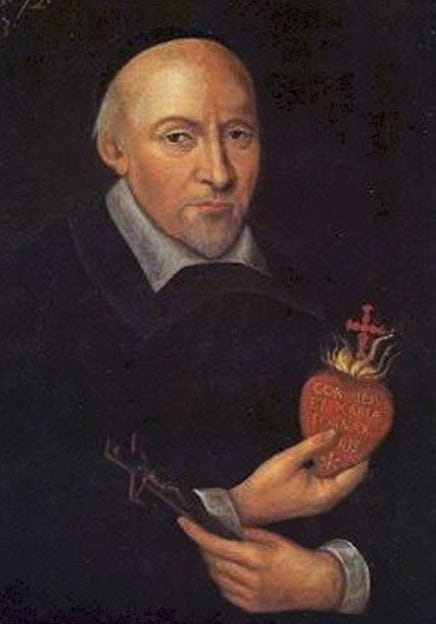
So before I fall asleep at my desk, let me just tell you — it’s the feast of St. Jean Eudes. He fought the Jansenists. He loved the Sacred Heart. He spent a lot of time in the confessional.
Fathers — Be like St. Eudes. Lay people — Try to find a priest like St. Eudes.
That’s all I’ve got. Let’s do the news.
The news
There was no Pillar Post on Friday, so I’ve got a lot to sum up for you. Here goes:
Maybe when you read that, it was confusing to you. Because maybe, like the rest of us, that seemed like news from the Obama era, more than a decade ago. Maybe — like me — you had no idea that the Little Sisters of the Poor were still plugging away in court, with one piece of litigation after another.
But that’s what has been happening.
It usually doesn’t.
And sometimes, running away to sea adds more problems to life. Like, how do you go to confession when you live on a cargo ship? How do you get to Mass? And more basically, how do you get to the bank?
If you do take to sea, you’ll find all those questions are answered by the dozens of chaplains serving U.S. ports and the seafarers who visit them.
Those seafarers are cared for by the Apostleship of the Sea.
And this week, Jack Figge tells you all about ‘em.
There are some big jobs open at the Vatican right now. So what will Pope Leo XIV do?
Edgar Beltran does some analysis from Rome.

You shouldn't have to pick between getting things done and living a full Catholic life. With The BIG Catholic Planner and Calendar, you don't have to. Its 3-phase planning funnel helps you identify responsibilities and get tasks done, all through the lens of the life of the Church. Pillar readers get 20% off with code PILLAR at BigCatholicCalendar.com for a limited time.
The Pillar broke the news of a Vatican-commissioned investigation into allegations of coverup and financial mismanagement made against Cardinal Carlos Castillo, archbishop of Lima, according to senior archdiocesan sources in Peru.
You can read about it in English, or in Spanish.
—
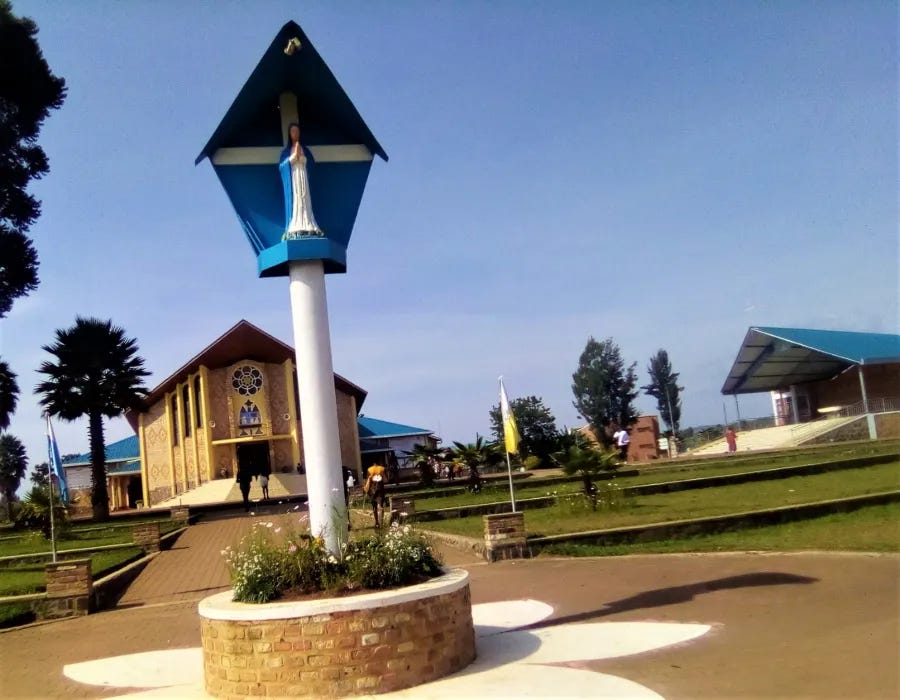
A new shrine was dedicated last week in Philadelphia to Our Lady of Kibeho, the only Vatican-approved Marian apparition in Africa.
—
In Newfoundland, the Archdiocese of St. John’s is in a legal dispute with Catholics and a local historical society over who really owns a church property up for sale.
There’s a lot to this story, and probably a follow-up explainer coming, but to start, we talked with the archbishop, the communities, and tried to understand where things stand. Read the latest here.
—
The Diocese of Birmingham, Alabama announced last week that one of its vicar generals has been removed from ministry after being accused of maintaining a sexual relationship with a 17-year-old girl.
So what happens now? The Pillar breaks it down.
—
A Hong Kong court heard final arguments Monday in the trial against the jailed Catholic publisher Jimmy Lai, with prosecutors saying Lai’s international connections proved his “unwavering intent” to bring international sanctions against China and Hong Kong.
A longtime collaborator of Lai’s told The Pillar that Lai’s conviction seems inevitable, but those close to Lai hope it could end up helping to clear the way for his eventual release from prison and deportation.
—
Vatican Secretary of State Cardinal Pietro Parolin inaugurated last Thursday a memorial to the slain nuncio Archbishop Michael Aidan Courtney in Burundi.
Courtney was killed in December 2003, while he tried to negotiate peace between Burundi’s government and warring rebel factions.
He is the first apostolic nuncio to die by violence in more than 500 years.
—
Catholics online have had questions, after the Vatican announced the inclusion of an SSPX pilgrimage in an official list of events for the Jubilee Year.
Wait, the inclusion of an SSPX pilgrimage? For the Jubilee Year? At the Vatican?
Well, kinda. As it turns out, there is much more to the story than what you might have read on twitter.com.
—
Finally (finally!) there is big news out of France, where the Archbishop of Toulouse on Saturday announced that Fr. Dominique Spina — who did four years in prison for sexually assaulting a minor — had resigned from the office of chancellor, at the archbishop’s request.
Except, this probably isn’t the end. Because while de Kerimel announced a change-of-course on Saturday, his statement was extremely controversial.
The archbishop explained that he had asked Spina to resign in order to quell division in the French episcopate over the subject.
At the same time, he defended Spina’s appointment to the office of chancellor.
“My decision was interpreted by many people as a snub to the victims of sexual abuse; I ask the victims' forgiveness. This was obviously not my intention. Others finally saw it as a sign of hope for the perpetrators of abuse who had served their sentence and are experiencing a very trying social death. Here, I must ask forgiveness from the one I named and in whom I trust, for not having been able to find the rightful place to which he is entitled,” the archbishop wrote.
He then framed the prospect of restrictions on a child abuser — or even prudence regarding his future assignments — as a kind of revenge.
“What should be done in this case?” the archbishop asked. “Practice revenge? That would be to lock oneself into a destructive logic and ultimately into the ultimate victory of evil.”
“France has renounced the death penalty; justice believes in the possibility of change for criminals and works towards their rehabilitation. It cannot give free rein to revenge; this would be to the detriment of the perpetrator, of course, but also of the victim and of society as a whole. In the name of such justice, we would fall into the worst injustices. Justice does not return to the perpetrator the harm he has done to the victim: ‘an eye for an eye, a tooth for a tooth.’ It places a limit on the exclusion of the guilty party, except in extreme cases involving dangerous individuals.”
In short, de Kerimel’s argument seems to be that any prudential judgment regarding restrictions on Spina — not laicized because his victim was 16 at the time of the crime — is a kind of evil, equivalent to the death penalty.
I don’t know much about de Kerimel, but I do find myself wondering if he chose those words — especially the bit about France rejecting the death penalty — with a high degree of forethought.
You see, in the life of the Church, there has been debate about the notion of “zero tolerance” for sexual abusers for decades.
While American bishops committed themselves in 2002 to a “zero tolerance” approach — meaning that a person guilty of child abuse would never be returned to ministry — that commitment has often been criticized by European bishops, who have sometimes framed it as an especially American idea — fundamentalist, reactionary, and — perhaps the greatest crime of the Continental mind — unnuanced.
For the past two decades, there has been an undercurrent of European churchmen eager both to frame child sexual abuse as a uniquely American problem, and to suggest that American solutions are unmerciful and cruel, failing to appreciate the complexity of the human condition.
I suspect that summary is enraging you, American readers, because to the American mind of 2025, it seems manifestly obvious that a person who commits sexual abuse against a child should never be placed in a position of responsibility, high status, or opportunity again.
But de Kerimel demonstrates that is not a universal viewpoint, even if he now seems to be one of the last holdouts in the French episcopate. I suspect — and I might be reading too much into things — that the reason de Kerimel so frequently compared “zero tolerance” to the death penalty is precisely to associate it with Americans, to suggest that it’s just another form of American fundamentalist barbarism.
I suspect most Pillar readers — though not all — oppose the death penalty, but support a zero tolerance approach to the assignment of clerics criminally convicted of sexually abusing minors.
But it’s worth understanding that zero tolerance approach — which seems now intuitive to most of us — is not universal. If Leo aims to take up the reform of governance at a universal level, he’ll have a lot of work to do that seems very basic to many Americans, but is obviously needed in places like Toulouse.
Laicization and annulments
Ok, a reader wrote to me with an interesting question about Toulouse, and I want to answer that for you, too. So here’s a little explainer.
This reader noticed that on social media, and in our own comments section, many people have said that Fr. Spina, the former chancellor of Toulouse, should have been laicized for his crimes.
Today, he would be laicized — he wasn’t because at the time of his sex crimes in the 1990s, canon law defined a minor — for purposes of the statutes regarding sexual crimes — as a person under 16 years of age. Spina’s victim was 16 years old.
Today the law has changed, and abusing a 16-year-old in 2025 would canonically constitute abuse of a minor.
But this reader asked an interesting question about laicizations in general.
See, if a man married for years committed some horrific crime, the crime would not necessarily be taken as grounds for annulment.
So, this reader wanted to know, what’s the difference? Why would something be “grounds” for laicization, and not grounds for annulment?
Here’s the answer:
An annulment — or declaration of nullity — is a decision that an attempted marriage was invalid because of some problem at the time of attempted consent.
A legal process determines whether there was something missing in the consent itself, or something defective in the person’s act of consent.
In other words, an annulment process asks:
Did they say “I do” to what marriage really is?
And were they really able to say “I do” in the first place?
If the answer to either question is “no,” the marriage can be determined to be invalid.
Laicization doesn’t ask whether a man was validly ordained a priest, deacon, or bishop.
Instead, a rescript (or penalty) of laicization says that while a person is a priest (or deacon/bishop) sacramentally — and that sacramental identity is forever — they are henceforth excluded from the legal class of people able to engage in the ministry of the ordained — a class we call the clerical state.
Members of the clerical state are ordained men (usually) eligible to engage in ordained ministry, who have a right to financial support from the Church.
Exclusion from that state can come because a person requests it, or it can come as a penalty — a finding that a person’s actions no longer warrant the Church’s trust, support, and inclusion in the class of people potentially eligible for assignment in ordained ministry.
It is theoretically possible for a man’s ordination to be found invalid. In 2020, a Detroit man named Fr. Matthew Hood discovered he wasn’t validly baptized, and thus had been invalidly ordained a deacon and priest — he chose to be baptized and ordained validly in relatively short order — but such cases are exceedingly rare.

On your soap box.
Today is the 91st anniversary of the first annual All-American Soap Box Derby in Dayton, Ohio.
Every year, kids from across the country qualify to meet on a big Ohio hill, on a custom built track, to race home-built cars, hoping to be declared the soap box national champion.
This is a great American custom, run with a real mom-and-pop sense of community.
But in the year 2000, soap box racing changed forever.