
Paid Pillar subscribers can listen to JD read this Pillar Post here: The Pillar TL;DR
Hey everybody,
Just a reminder that Ed is on vacation, and I’m JD. Further, Michelle is away, and I’ve sent Luke home early after a long day toiling in the salt mines. So the copy editing of this newsletter might be substandard. Bear with me. It’s summertime.
With that said, today’s the feast of St. Ignatius of Loyola, and you’re reading The Friday Pillar Post.
Because you’re reading the Pillar Post, I assume you already know about St. Ignatius, and I don’t need to rehash much about him here. And yesterday was the feast of Blessed Solanus Casey, but I’m guessing you already know about him, or you’ve read about him at The Pillar a few times.
But I bet you don’t know about St. Elin of Skövde, who is the decidedly-less-famous undercard saint of the day — it’s her feast, but she’s clearly not the main event.
Elin needs better promoters though — she should be much more famous than she is. Her story is remarkable.
She lived in southwest Sweden in the 1100s. She was probably noble, and she was rich. Her dad was rich, and then her husband was rich. He died a few years after they married, leaving her with a young daughter, and maybe other children.
But Elin didn’t remarry. Instead, she put her wealth in service to the Gospel — she set up works of mercy for the poor, and she helped build several churches. One of those churches was in a place called Götone. The story says that when that church was built, she insisted on a portico between the church and its baptistry. She told the builders that God would provide the relics of a saint to be placed there.
He did. This is how:
In the early 1160s, Elin went on a pilgrimage to Jerusalem. By then, her daughter was grown and married. And while Elin was traveling, her son-in-law was killed by his own servants. When they were caught, they said that Elin had put them up to the murder.
There were no witnesses. She had no trial. Instead, when she returned to Sweden, she was killed by her son-in-law’s relatives, who found her in Götone and stabbed her to death.
Even when she died, few believed that the accusation against her was true. She suffered the consequence for it unjustly. And then people began praying for her intercession. Some reported miracles.
Elin was canonized just years after her death — and pilgrims continued reporting miracles at her tomb for centuries.
She was falsely accused, and she died over a lie. Any of us who has been misunderstood, gossiped about, or falsely accused could use her intercession.
The news
Ten years ago this week, Pope Francis created a diocese for Syro Malabar Catholics in Great Britain.
As the eparchy reflects on that milestone, The Pillar interviewed Bishop Joseph Srampickal, who says that the Eastern Catholic Church he leads is not just for ethnically Indian Catholics living in Britain. Instead, he said that “the Syro-Malabar Eparchy of Great Britain ... can play a significant role in the revival of the Catholic Church.”
How? Well, he says, “by witnessing to the richness of our Eastern Christian tradition, we have the potential to contribute to a new evangelization and offer a distinctive spiritual witness to the Church in Great Britain.”
—
It’s still summertime. (And too early for all the back-to-school emails I’ve been getting this week.)
So the question for parishes, and even for families, is how to support young people after they’ve come down from the mountain, so to speak. And for insight on that, The Pillar talked with veteran youth leader Eddie Cotter, who is one of the most interesting people we know.
Meet some of the most interesting, right here.
—
A Polish man has been identified as the main suspect of a vandalization and desecration of the Medjugorje shrine in Bosnia on July 28.
Security camera footage showed a man dousing the altar of Saint James Parish in the Bosnian town of Medjugorje with a flammable liquid and setting it on fire during the early hours of Tuesday morning.
According to local media, police in the nearby town of Citluk received reports early the same morning that several statues of Our Lady had been vandalized, covering her face with black graffiti and with messages such as “Medjugorje is a deception,” “Only Jesus,” and blasphemous phrases.
Here’s the story — along with a little reminder on what the Church actually has to say about Medjugorje.
—
Pope Leo XIV approved this week the practical union of two Irish dioceses under a single bishop. The dioceses are the fourth set in the country to be united in persona episcopi in recent years, signifying the impact of declining religious practice in Ireland.
—
Turns out those places are pretty cool. Read all about ‘em.
Is it possible that Pope Leo is preparing to recognize the head of the Ukrainian Catholic Church as a patriarch?
Yes. It is possible. Read about it here.

In celebration of Archbishop Sheen’s approaching beatification, St. Bernard’s School of Theology and Ministry cordially invites you to a conference October 23rd – 25th reflecting on his total witness: his life, his thought, and his holiness. All who know and love Fulton Sheen are welcome to attend; a special invitation is extended to those who seek to learn more about him. Learn more here!
Two of the appointments are American bishops: Archbishop Salvatore Cordileone and Bishop Edward Lohse of Kalamazoo.
The appointment of Cordileone, especially, should be taken as a very significant pick from Pope Leo. Vatican sources have told The Pillar in recent years what Vatican observers probably surmised — that Cordileone spent much of the Francis papacy out of step with elements of the curial zeitgeist in Rome, and not always well received in Rome as a result — especially after the archbishop’s 2022 decision to prohibit Congresswoman Nancy Pelosi from reception of the Holy Communion.
Cordileone’s appointment to the Signature signals that Leo does not intend to be hidebound to the personal politics of the Francis papacy. It is, in short, the sort of move which communicates just how much water has now passed under the bridge.
—
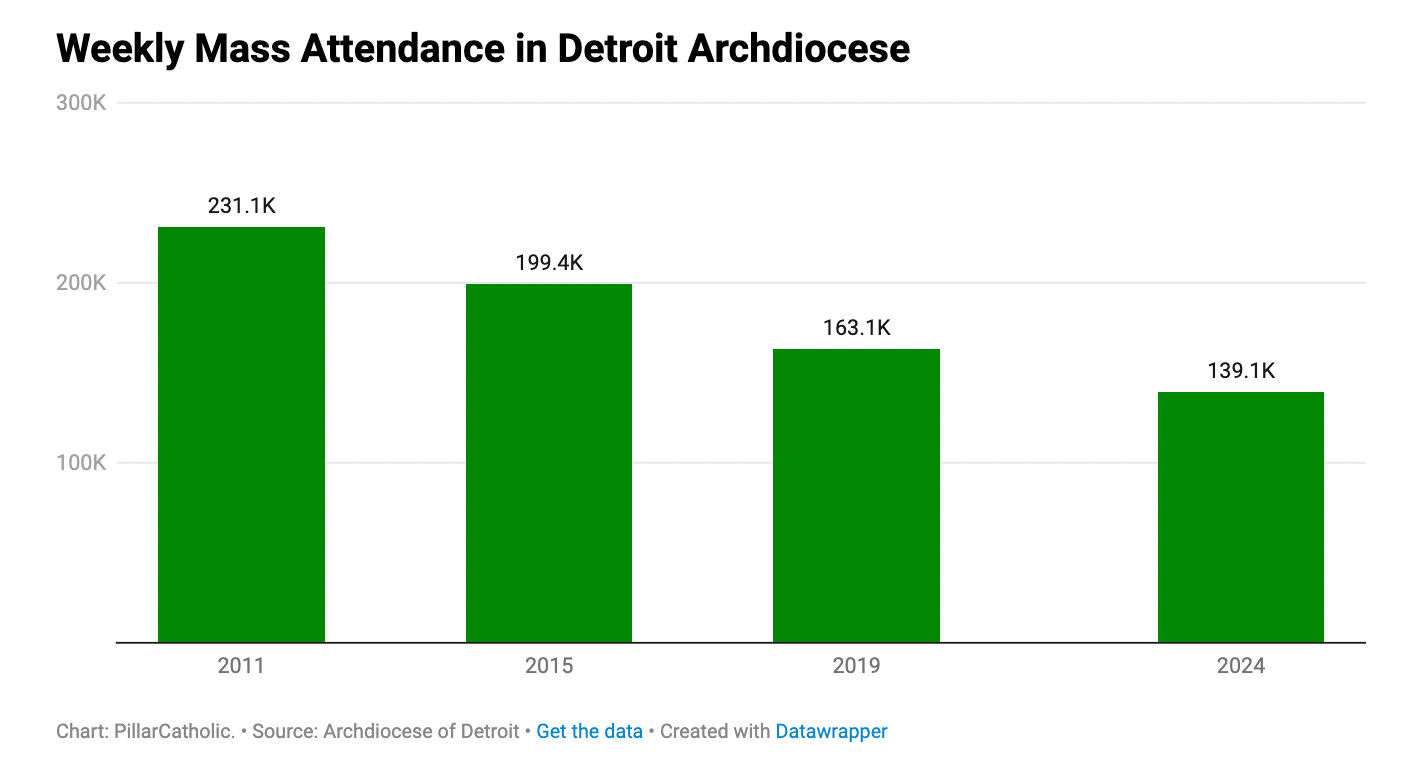
Like many US dioceses, the Archdiocese of Detroit is going through a parish consolidation process.
In the preparation, the archdiocese has posted an uncommonly detailed set of presentations — one for each parish in the archdiocese — providing the data diocesan leaders are assessing as they make these decisions about the closure or merger of parishes.
So Brendan Hodge dove into the numbers. They offer some interesting insights.
“Some of these people may fear judgmental stares and rejection that further wounds their dignity. For these people, our clinic represents a place they can access free of charge, without needing a referral, and where they can be certain to find qualified people who will welcome them with open arms and outstretched hands. Anyone in need who comes to us is welcome—a brother, a sister. That is enough,” Archbishop Luís Marín de San Martín told The Pillar.
“Our doctors welcome them warmly, listen to them, and are there for them. The poor are at the heart of their service. This is because they see Christ in their faces, and by healing them, they heal Christ. Many of those who come to us need to talk, to share their story. Although it would be desirable for this same welcoming attitude toward the most vulnerable to be present in all healthcare facilities and institutions, I believe we must start with ourselves.”
Cupich, subsidiarity and synodality
Cardinal Blase Cupich gave this week an interview to a news portal of the German bishops’ conference, in which some remarks came as a surprise to American observers of the cardinal.
Speaking about authority in the life of the Church, Cupich touched on the topics of solidatity and subsidiarity. And — speaking to German Catholcis — he warned that leaders “must be careful to remain united during this time and not allow a situation to arise in which a bishops’ conference takes a path that violates the unity of the whole Church.”
The remarks are significant because I would not have expected even the penumbra of a correction from Cupich of the German “synodal way,” and yet, there it was, in plain text, for all who have eyes to read.
I’m not sure how the warning will be taken in Germany, or in Rome, where it was more likely meant to be heard.
But however that shakes out, I’m struck by a different claim from Cupich in the interview, one which repeats a common misunderstanding of Catholic social teaching — but most commonly, a misunderstanding associated with the American political right, inside and outside the Church.
It is important, Cupich told German Catholics, that in the life of the Church “we respect the principle of subsidiarity.”
“This means that decisions should be made at the lowest possible level before Rome or a higher authority intervenes.”
This is a uniquely American spin on subsidiarity — the idea that the “lowest possible level” should always solve the problem first.
But it’s not actually how the Church views subsidiarity. Drawing from Pius XI, the Catechism explains that subsidiarity means: “a community of a higher order should not interfere in the internal life of a community of a lower order, depriving the latter of its functions, but rather should support it in case of need and help to co-ordinate its activity with the activities of the rest of society, always with a view to the common good.”
In other words, communities of lower orders have certain functions, and those should be allowed for, even supported. But communities of higher orders have certain functions, too.
This distinction is not just abstract. It means that “lower order” community of an episcopal conference — not a natural or divinely ordered community, by the way, but a creature of positive law — should fulfill its functions, as delineated in the law, while the universal Church, guided and led by Peter, should fulfill its own.
Subsidiarity is not localism-at-all-costs, or a preferential option for close-by dictators or demagogues — either in the Church or in civil society.
Real subsidiarity means knowing what each sphere of society is for — its telos — and then ensuring the proper ordering of social spheres, so that each can do the thing for which it exists.
If we don’t get that right, we’ll get a lot of ecclesial questions wrong, and a lot of civic ones too? Don’t believe me? Well, ask yourself how synodality got off the rails — when it did — and you’ll see exactly what I mean.
Papal house parties
Pope Leo received at the Vatican today punk rock icon Patti Smith today, in a moment that seemed to be pretty exciting for both of them.
The pope’s getting picked on a little bit, because Patti Smith is apparently pro-abortion, but, if you ask me, the pontiff is and should be allowed to meet with people who disagree with Catholic doctrine — in fact, that strikes me as a crucial part of the job for anyone entrusted with the great commission. In fact, that’s how the great commission actually happens.
Smith is also controversial to some because she has some 1970s lyrics critical of organized religion, though since 2014, she’s been at the Vatican a few times, once playing a Vatican Christmas concert for Pope Francis and the Vatican’s employees.
I don’t know anything about Patti Smith, because I don’t pay a lot of attention to rock icons in general, but I’m glad for the pope that he seems to regularly invite to his office people from sports, culture, or the arts whom he admires or just appreciates.
There are not a lot of actual perks to the papacy, if you ask me, but one is that you can summon nearly anyone you want to a meeting, and they’ll come.
So if you become pope, here are my suggestions for making the most of your invitatory power:
—Invite the rock stars you like. Invite the athletes you like. Basically, if there’s anyone you’ve ever wanted an autograph from, invite them to the Apostolic Palace.
But don’t have them just sit at your desk and talk. That’s a waste.